Spider Hunting Methods
Spiders are predators, above all else, so hunting and killing is where they really shine. In the bug world, spiders are fairly fearsome animals -- they're the tiny equivalent of wolves, lions or sharks.
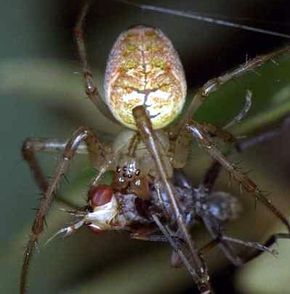
![]() Photo courtesy Ed Nieuwenhuys An orb web spider feeding on a fly |
Different spiders employ different hunting strategies. As we saw in the last section, some species build intricate webs to ensnare passing insects. Other spiders, such as the various wolf spiders, seek their prey out on the ground. Trap door spiders dig holes, cover them up with dirt doors hinged with spider silk, and lie in wait for passing prey. Similarly, some spiders hide inside flowers to catch feeding insects by surprise.
![]() Photo courtesy Ed Nieuwenhuys |
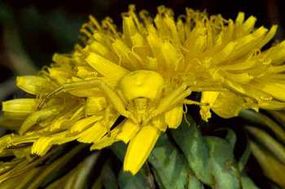
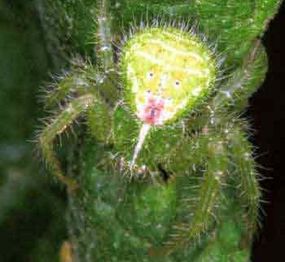
![]() Photo courtesy Ed Nieuwenhuys Two examples of crab spiders camouflaging themselves to catch insects off guard: Misumena vatia, the yellow crab spider above, can change its coloration over a couple of days to match flowers and other surroundings. |
In the next section, we'll find out what spiders do when they catch their prey, whether in a web or on the ground.
|
Jumping spiders, as you might expect, have the ability to jump great distances -- as far as 50 times their own length. They don't have particularly strong muscles in their legs; they actually spring forward using hydraulic pressure. A powerful muscle in the cephalothorax squeezes fluids from the body into the legs to make them expand.
With more than 5,000 species around the world, jumping spiders are one of the more common spider varieties around. They're characterized by large eyes, which help them spot potential prey at a good distance. In contrast to web-spinning spiders, most jumping spiders hunt sort of like cats, stalking their prey and then springing on them at high speed.
|