Introduction to Are chimpanzees evolving in the wild?
If you were to put a sample of chimpanzee DNA next to a sample of human DNA -- and if you had any idea what you were looking at -- you would see that the samples are nearly identical. Chimps and humans share 96 percent of their DNA, and some new research suggests that chimps and humans may have split off from a common ancestor just 4 million years ago, which is a more recent estimate than the generally accepted timeframe of 5 to 7 million years. This would mean that it took about 4 million years for humans and chimpanzees to become completely separate species. The two are so close on the evolutionary ladder that observing chimps offers real glimpses into the way humans may have evolved. And a new, pretty major observation of chimp behavior may provide scientific evidence of a long-suspected theory about human evolution.
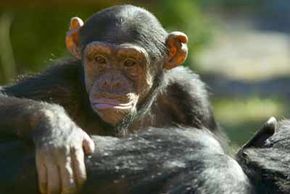
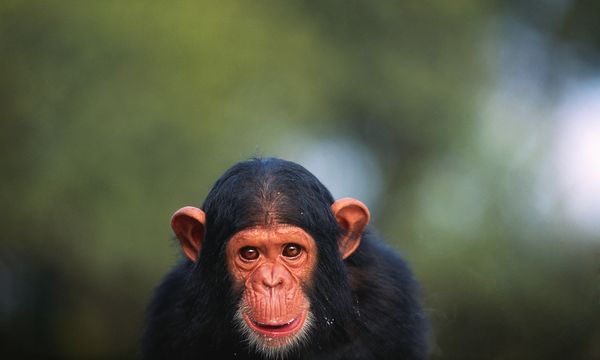
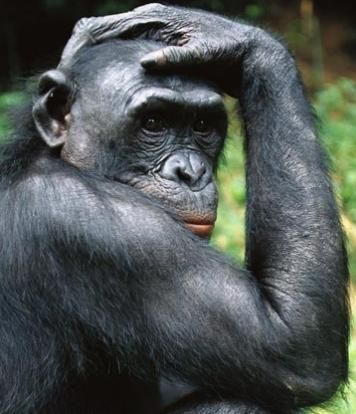
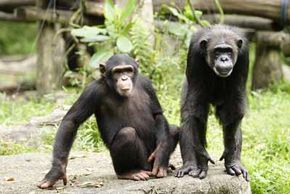
Researchers have found that chimpanzees share 96 percent of their DNA with humans. See more primate pictures. |
Take this quiz from Animal Planet to find out if you could make it through the same initiation phases that orphaned chimps have to go through: Chimp Initiation Rites Quiz |
Crucial Female Roles
When a joint research team from Iowa State University and the University of Cambridge studied chimps in the wild, what they saw was a fairly methodical, step-by-step process of fashioning what most of us would recognize as a spear. The chimps would first break off a live tree branch, usually about 2 feet (0.6 meters) long; then pull off any leaves and twigs; then, in many cases, scrape off some of the bark at one end of the stick and create a point at that end of the stick by gnawing away at the tip with their incisors.
The sharp-point part is a big deal, because no one has seen a chimp sharpen a stick in order to use it to enlarge a hole in a log. This element supports the case that the chimps are creating a spear.
The chimps would then jab the stick into a hollow tree branch or a hole in a tree trunk, which are places where a lemur-related animal called a bushbaby (Galago senegalensis) sleeps during the day. The jabbing was in the motion humans typically think of as "spearing." Of 22 observed cases of this type of action, Pruetz and Bertolani saw only one in which the spear actually pulled a bushbaby out of a tree. But in some cases, the chimps would jab wildly with the stick and then pry open the hole from a bit of a distance in order to get to the bushbaby. Pruetz explains that this seems to indicate the chimps are in fact trying to kill or immobilize the animal with their jabbing, because bushbabies are quick -- if the animal were unharmed when the chimp pried open the hole, it would easily scurry away and evade capture. Also, the chimps would usually sniff or lick the spear after pulling it out of the hole, and the researchers found discarded spears with bushbaby fur stuck to them.
![]() © Photographer: Courtney Keating | Agency: Dreamstime Some scientists believe that chimpanzees are evolving in the wild. |
There is a common belief in the scientific community that females played a key role the evolution of human tool use. As observed in the chimpanzee community, the adult males are typically the last to pick up a new method of accomplishing a task. The adolescent males and females seem to be far more open to adaptation. And since adolescents spend most of their time with the females of the community, biologists have theorized that females are the primary innovators in tool use. The females use tools to adapt to changing conditions and pass along the adaptations to the young of the group, who easily pick up the new tool use. The adolescents eventually become the alpha males and the offspring-rearing females, solidifying the new tool in the daily life of the group. With 96 percent of human DNA matching chimpanzee DNA, the latest observations of female-dominant tool innovation in a chimpanzee community could provide fuel for the theory of female-driven tool innovation in human evolution.
To learn more about chimpanzees, evolution and related topics, check out the links on the next page.
Lots More Information
Related HowStuffWorks Links:
- How Bigfoot Works
- How Evolution Works
- How Gene Pools Work
- Is there a difference between monkeys and apes?
More Great Links:
- Huliq: Chimpanzees lend insight into human evolution - Mar. 2, 2007
- The Jane Goodall Institute: Chimpanzee Central
- ScienceDaily: Chimpanzees Discovered Making And Using Spears To Hunt Other Primates
- National Geographic Chimpanzee Profile
Sources:
- Beeman, Perry. "Chimps hunt with spears, ISU researcher finds." The Des Moines Register. Feb. 23, 2007.
http://desmoinesregister.com/apps/pbcs.dll/article? AID=/20070223/NEWS/702230385/-1/NEWS04 - "Chimpanzees and humans 'split' later than thought." Reuters. Gulfnews. Feb. 25, 2007.
http://archive.gulfnews.com/articles/07/02/25/10106763.html - "Chimpanzees found to use tools to hunt mammalian prey." Innovations Report. Feb. 23, 2007.
http://www.innovations-report.de/html/berichte/ biowissenschaften_chemie/bericht-79494.html - "Chimpanzees 'hunt using spears'." BBC News. Feb. 22, 2007.
http://news.bbc.co.uk/2/hi/science/nature/6387611.stm - "Spear-Hunter Chimpanzees?" The Associated Press. THV. Feb. 23, 2007.
http://www.todaysthv.com/news/news.aspx?storyid=42153