You'd think the second largest group of land mammals on Earth would be a pretty confident bunch. But not rhinoceroses: These guys are so defensive that they've earned a reputation as indiscriminate attackers that will charge just about anything in sight.
These giants -- whose name comes from the Greek word rhino, meaning "nose," and ceros, meaning "horn" -- don't run at things out of paranoia, though. While they have few natural predators due to their lethal horns and imposing bulk, humans have driven them nearly to extinction. There are actually five species of rhinoceros -- two in Africa and three in Asia -- and every one of them is endangered. Overall, the world rhino population has declined 90 percent since 1970 [source: African Wildlife Federation].
Advertisement
The reason for the decline is fairly straightforward. Although some rhino populations are threatened by political instability and conflict, the majority of them have been killed because of illegal poaching. It turns out that the same horns rhinos use to fend off predators -- and occasionally each other -- are in high demand, especially in Asia. Among other things, the horns are used in ornamental carvings and are thought to possess a variety of medicinal properties.
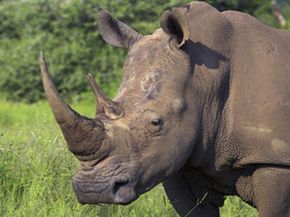
The horns aren't actually made of bone, but of keratin, the same protein that comprises your hair and nails. And they grow just about as fast, if not faster. Their horns grow as much as 3 inches (8 centimeters) each year and may reach lengths of up to 5 feet (1.5 meters) long [source: National Geographic].
Three of the rhino species, the Sumatran rhino of Asia and the black rhino and white rhino of Africa, have two horns -- a longer one at the front of their nose and a smaller one behind that. The other Asian rhinos, the Javan and the Indian species, have only one horn.
So despite their heft, which ranges from 750 to 8,000 pounds (340 to 3,629 kilograms), rhinos nevertheless have good reason to feel vulnerable -- and even a little bit angry [source: Defenders of Wildlife]. If someone was constantly hunting your family for the magical properties supposedly found in your nostrils, you'd probably have a chip on your shoulder too.
Thus, simple fear and self-preservation is one possible reason for the unprovoked rhino charges. Another is a bit more obvious -- unless, of course, your vision is as bad as theirs.
Advertisement