"Sit" and "stay" are usually the first commands that dogs learn.
Photo courtesy Hannah Harris
Although dogs have helped people with specific jobs for millennia, today most resemble family members more than employees. According to the American Pet Products Manufacturers Association, in 2005, American pet owners spent an estimated 39.5 billion dollars on their pets, more than twice what they spent in 1994.
While this represents a golden age for lucky dogs, the status of family member may also require that the dog meet certain standards of behavior. Although you might guess otherwise from the abundance of doggy fashions now available, dogs are not tiny, furry people. They have their own way of thinking and doing things. Thousands of dogs are surrendered to animal shelters each year, or permanently relegated to a backyard pen, simply for acting like dogs.
Advertisement
Dogs and people can live together happily, but this requires that owners make the effort to bridge the species gap and train their dogs to behave appropriately in human society. There are many different ways to train dogs and just as many trainers who will say that their way is the only "right" way, but the reality is that there are multiple methods that all work. The main difference between them is how quickly they work, and how enjoyable they are for dog and handler.
In this article, we'll explore the history and ideas behind most methods of dog training and talk about one of the most popular methods today: Clicker training.
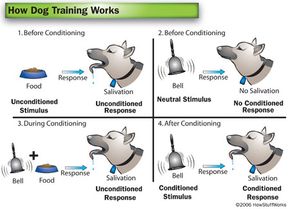
Dog training typically centers on operant conditioning. The first scientist to define this concept was B.F. Skinner, who studied the work of Russian physiologist Dr. Ivan Pavlov on animal behavior. In Pavlov's groundbreaking study, dogs learned that a stimulus (in this case, a bell) meant they were about to be fed. Starting with two things that are naturally paired -- salivating and being fed -- Pavlov added a third component by ringing a bell before feeding. After a few trials, the dogs learned to associate the bell with being fed and would react by salivating at the sound of the bell in anticipation of their food but without any food present.
Since dogs naturally begin salivating when offered food, food is an unconditioned stimulus. No conditioning or special training is necessary to cause the dog to salivate, which is an unconditioned response. In contrast, a ringing bell does not normally cause dogs to salivate; they will do so only if they have been conditioned to associate a bell with being fed. Therefore, the bell is a conditioned stimulus. The dog's new reaction is a reflex to the stimulus and is a conditioned response.
Advertisement
Many of us see this today with our own dogs when they break into a frenzy of barking at the sound of the doorbell, sometimes even a doorbell on television. In this case, the dog has been conditioned to associate the stimulus of the bell with the imminent arrival of a stranger.
When we see flashing lights or hear a siren behind us while driving, we may reflexively tense up and our heart rate may increase. We have been conditioned to associate the sound of sirens with the unpleasant and stressful experience of getting a ticket. This is classical conditioning. Both animals and people can learn to relate a pair of events and respond to the first in anticipation of the second. This type of learning is passive and involuntary; it occurs without the learner doing anything and often without awareness.
While Pavlov's work dealt with a reflexive reaction to a conditioned stimulus, Skinner became interested in creating a specific behavioral reaction to a stimulus by adding a reinforcer. A reinforcer can be either a reward or a punisher. A reward is anything that increases the frequency of an action; a punisher is anything that decreases its frequency.
When we are rewarded for a certain behavior, we are likely to repeat that behavior. When we are punished for a certain behavior we are likely to stop. This type of learning is active and voluntary; it depends on the actions of the learner.
Because the definition of a reinforcer is based on its effectiveness, it's important to remember that a reward for one person may not be meaningful, and thus not a reward, for another. Similarly, what is a reward in one context may not be somewhere else.
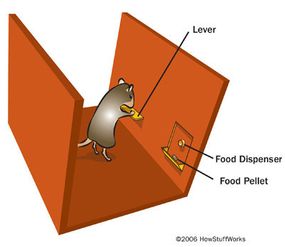
A rat in a basic Skinner box
Skinner showed that both animals and people would perform certain behaviors for a reward. In his experiments with rats and pigeons, Skinner showed how animals could learn to press a lever to get a food reward. When the animals were first introduced to the test box they moved around randomly. When they accidentally depressed the lever, a food pellet was dispensed. They quickly learned to depress the lever on purpose to get a pellet. He also shaped behaviors that are more complicated by reinforcing them step by step. Skinner called his approach "operant conditioning" because the animal's behavior actually operated on the environment (pressing the lever) in response to the anticipated outcome (getting a food reward).
Rewarding to encourage good behavior and punishing to discourage bad is something most of us do instinctively; it's common sense. Operant conditioning had a long history in animal training even before it was ever defined. Colonel Konrad Most, who published "Training Dogs: A Manual" in 1910, was using many of the same principles that Skinner studied, decades before he described them. Col. Most's training methods seem somewhat harsh by today's standards, but he is considered by many to be the father of modern dog training. Most, and other trainers used both rewards and punishers to shape and reinforce desired behavior.
Next, we'll look at how reinforcers are used in animal training.
Advertisement
Reinforcers
It's important for parakeets and other birds kept as pets to be hand-trained.
Photo courtesy Hannah Harris
Reinforcers can involve either the addition of a new element or the removal of an element currently present. The terminology for this is a little confusing, but adding something is referred to as "positive," though not necessarily in the sense of "happy" or "good." "Negative," in this case, is the removal of something, and doesn't necessarily mean "bad." Therefore, both rewards and punishers can be either positive or negative.
Giving a parrot a piece of fruit for waving its foot is an addition of something good (a positive reward); a horse moving faster to stop the pressure of spurs is the ending of something bad (negative reward). Even though "negative reward" sounds like an oxymoron, the removal of something bad is a kind of reward.
Advertisement
Some commonly used positive punishers include shock collars, prong collars and choke chains.
Photo courtesy Hannah Harris
There are many ways to teach a dog to sit using a reinforcer. The trainer may push or lure the dog into a sitting position, or he may simply wait until the dog sits naturally on its own. Once the dog sits, the trainer may offer a positive reward such as verbal praise ("good boy!"), tactile praise (a pat on the head), a favorite toy, or a treat. Some trainers use negative rewards like electronic collars to administer a mild shock to the dog, which stops as soon as he sits. The dog learns he can eliminate the shock by sitting. For ethical reasons, many people frown on this. However, it follows the same principles of operant conditioning. In every case, the dog will learn that when he hears the command "sit" and he sits, he will get a reward.
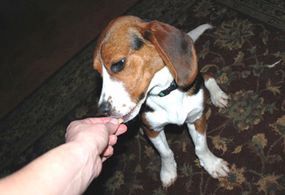
Many people prefer to use treats as reinforcers when training.
Photo courtesy Hannah Harris
Reinforcers can be almost anything as long as they are meaningful to the dog. One dog may think treats are more valuable than toys, while another may feel the opposite. It doesn't really matter what the reinforcer is, but for practical reasons, some reinforcers are easier to work with than others. Also, the same reinforcer doesn't have to be used every time or in every situation. Some tasks may require a more valuable reinforcer than others. As PetSmart obedience trainer Dan O'Leary puts it, "you would probably step over a chair if I offered you a dollar to do it. But you probably wouldn't wash and wax my car for a dollar." Similarly, your dog may work for one type of reward in the relative calm of your home but may need something more desirable to maintain focus in class.
We'll look at how trainers developed markers, or cues, to train animals other than dogs.
Advertisement
Markers
Performing dolphins
Photo courtesy Paul Anderson / MorgueFile
Keller and Marian Breland were students of B.F. Skinner and expanded his techniques to train a variety of different kinds of animals. In the 1950s, Keller Breland began developing a training program for marine mammals. For obvious reasons, it is difficult and dangerous to design an effective punisher for a dolphin or an orca. It is also challenging to reward a marine mammal promptly because they are in the water, and the trainer is often some distance away on land.
Many of the same problems are inherent in training dogs. If a dog sits, then jumps up, spins around and is given a treat, it will probably not know which part of the performance pleased the handler. This is especially true if it took a minute for the trainer to pull out the treat and present it to the dog. Typically, the dog will pair the reward with the final behavior that it performed before it got the treat. So if the dog sat, then jumped up and got a treat, what it's really being trained to do is jump up, not sit.
Advertisement
This is also true of punishers. If a dog runs away from its owner and engages in a game of hide-and-seek, it is natural for the owner to punish the dog when he catches it. However, the last thing the dog did before being punished was come to the owner. So coming when called is the behavior that is likely to decrease, instead of running away.
Breland solved this problem by designing a marker, or cue, that would let the animal know it had performed correctly and would be getting a reward shortly. Breland used classical conditioning to pair a marker signal with a reward, so that when the animal heard the signal it knew it would be getting a reward. Then he used operant conditioning to shape behavior using positive rewards.
The marker helps to reinforce the correct behavior because it is immediate. The marker is not the reward; it is simply a signal that the behavior was correct and a promise of a reward to come. Because marine mammals are naturally oriented towards communication via sound, it made sense to use a whistle blast as the marker.
Karen Pryor used the same positive reinforcement techniques in the 1960s to train dolphins. She realized the broad applications of this type of behavioral modification and in 1984 she authored the book "Don't Shoot the Dog," which, despite the title, is not really about dog training. It covers using positive reinforcement to shape the behavior of anyone from pet cats to difficult teenagers. Many businesses still use this book to teach their employees about effective management.
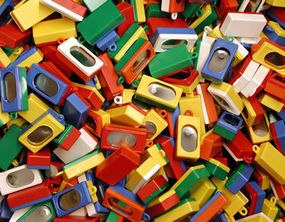
Basic metal clickers are often used as markers.
Photo courtesy HowStuffWorks Shopper
Pryor used a metal clicker as a marker to begin shaping the behavior of dogs, as well as many other animals and hers is the name most commonly associated with modern clicker training. Her techniques were adopted by other trainers and with the advent of the Internet, clicker training spread rapidly.
Karen Pryor describes the click as taking a picture of the behavior that you want; you snap it in that second. The click means, "you did something, it was the right thing, and you will be getting a treat for it."
Many beginning trainers make the mistake of clicking to mark a behavior, but then not following the click with a treat. With no actual reward, the dog may continue to offer the behavior for a while but it will eventually disappear.
Next, we'll learn how to introduce commands.
Other Markers
A marker doesn't have to be a clicker. It can be anything that marks the desired behavior. Dolphin trainers often use whistle peeps. Fish can be trained by flicking a flashlight on and off, and vibrating collars can mark behavior for deaf dogs. Some people mark behavior with a particular word, like "yes!" The marker can be anything that is short, specific, and consistent. On those grounds, care must be taken when using the voice as a primary marker because tone is often inconsistent and marker words or sounds may also be used in regular conversations and lose meaning for the dog.
Advertisement
Clicker Training: Introducing Commands
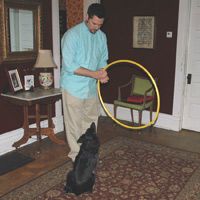
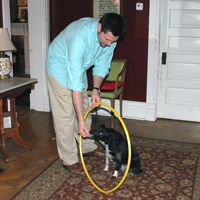
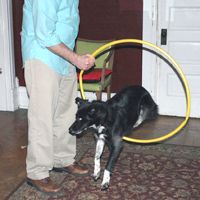
This dog is being trained, or shaped, to jump througha hoop.
Photos courtesy Hannah Harris
The clicker is not inherently meaningful to the dog. Like Pavlov's bell, the dog must learn that it means, "Treats are coming!" via classical conditioning. To do this, trainers "charge" the clicker by repeatedly clicking and then immediately offering a treat. In this way, the dog learns to pair the clicker with the treat. Once the dog knows that a click means a treat, it is ready to start learning new behaviors.
Trainers vary in their methods of eliciting a behavior. Some advocate using food to lure the dog into position. Others simply wait for the dog to offer the behavior simultaneously. Most clicker trainers do not advocate physically pushing the dog into position, as that is counter to the force-free philosophy of clicker training.
Advertisement
Once the dog offers the behavior, timing is critical. The trainer must click at the exact moment that he sees the behavior he wants. If the dog lies down and then rolls over before the handler clicks, rolling over has been marked as the desired behavior, not lying down.
Dogs can learn complicated behavior patterns using clicker training if you teach the sequence gradually. For example, if you wanted to train your dog to jump through a hoop, you might initially click and treat the dog just for walking up to the hoop. Once the dog is reliably walking up to the hoop, you would click only when it stuck its head through the opening, and then only when it walked through. Finally, you would click only when the dog actually jumped through the hoop. The standard for what will earn a reward keeps getting higher as the dog learns each new step. This is shaping.
Rather than giving a command and then teaching the dog what it means, most clicker trainers prefer to introduce the command only after the dog is reliably offering the behavior. Luring motions (such as holding a treat and moving it in front of the dog's nose, then to the ground to teach a dog "down") can be adapted into hand signals for commands by stylizing the motion and eliminating the food lure. Many trainers feel hand signals are easier for dogs to learn that verbal signals anyway, but having a dog that responds to either is ideal. Once a dog is offering the desired behavior, the handler can begin using the command so that the dog learns to associate the two. Eventually, the handler will only click the behavior if it was requested with a command, not when it's offered spontaneously.
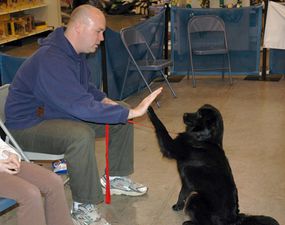
This dog has learned the hand signal for "high five."
Photo courtesy Hannah Harris
It's important to remember that animals are contextual learners. That means that they may understand a command in one place but not another. A dog may be able to sit flawlessly when the handler is standing, but become very confused when the handler gives the command from a sitting position. When training a new command, handlers need to add new contexts, backing up when necessary, to help the dog generalize.
Next, we'll look at how to use clicker training to get your dog to stop certain behaviors.
Interview with Dan O'Leary, clicker trainer at PetSmart in Lexington, KY
When and how did you get into training dogs?
Although I have had dogs since I was a child, I never truly trained one until 1979, when I got my first German Shepherd. After all, Shepherds were police dogs, or dogs like Rin Tin Tin, or Bullet (Roy Rogers' dog), so of course, they should be trained. So I signed up for a training class.
Have you ever worked training other species of animals?
Not until recently. I am currently training our 6 month-old kitten, using the basic principles of clicker training, to fetch and high-five.
Did you always use clicker training?
No.
What other methods did you use?
When I first began, no one was clicker-training dogs. I began with "traditional" training, using choke chains, prong collars and leash corrections.
What would you say is the biggest advantage to clicker training?
...for the people?
Many people would rather not have to use leash corrections and choke chains. Clicker training provides an alternative. Also, since clicker training does not require using physical force, a child or an older person can still train a big, strong dog.
...for the dogs?
Dogs who are trained with traditional methods are essentially punished, usually with a leash correction, every time the make a mistake. This can cause them to "shut down" when they are uncertain of what to do. Since doing the wrong thing brings punishment, the dog does nothing. Clicker trained dogs, on the other hand, will experiment, trying different things in the hope that they will find the behavior that brings a reward. They are more engaged on the training process.
Are there any disadvantages?
I don't believe there are any disadvantages for the dog. For the people, it seems to be harder to grasp the idea that a dog can be trained using primarily rewards rather than primarily punishment.
What is the hardest thing for people to master?
Good timing and consistency.
What usually brings people to your classes?
Typically people take a class because they have a behavioral problem they want to solve. Usually, it's common things, like housebreaking, destructive behavior, nipping, jumping, etc. Sometimes people have more serious problems, such as separation anxiety, aggression, or fear problems. Some of these problems can be addressed in a class situation and some may require private lessons.
Are there some breeds or temperaments of dogs that do better with this kind of training than others?
All breeds of dogs are trainable. What is easy and what is hard to train can vary greatly according to what the dog was bred to do. If a dog simply doesn't sit very often, it will take longer to teach Sit than to a dog who sits frequently. I believe it's about clear communication with the dog and discovering what is most motivating to the individual dog.
What do you wish people knew about clicker training?
Clicker training is effective, easy, and fun, for both the owner and the dog. And even children can be wonderful clicker trainers. Clicker training is dog-friendly and never involves harsh punishment or force. Dogs enjoy the mental stimulation of clicker training, and clicker training helps the whole family enjoy their dog because it strengthens communication and bonding.
Other thoughts or comments?
More dogs are euthanized each year for solvable behavior problems. Training dogs saves lives.
Hector, a Chihuahua mix, waits to be thrown the ball.
Photo courtesy Hannah Harris
It is much easier to teach a dog to do something good than it is to teach it not to do something bad. When breaking a dog of an undesirable behavior, the first thing to consider is what reward the dog is getting for it. He must be getting some reward or he wouldn't keep doing it, but sometimes rewards are subtle or counterintuitive. When a dog jumps up on his owner and the owner pushes him off, being handled is the physical reward and may be more powerful for the dog than the punishment of yelling. Handlers must be careful not to accidentally reward dogs for undesirable behavior. Once the handler identifies and eliminates the accidental reward (to the extent possible), the next step is often to train an incompatible behavior. The dog trained to sit when the owner picks up the leash cannot simultaneously jump up and knock her owner over.
The clicker is a training tool and handlers should not use it indefinitely. The purpose of the clicker is to communicate the desired behavior. Once the dog understands the command and performs it reliably, you can eliminate the clicker. You can still reward the dog, but over time you may shift from a highly prized food reward to a less desirable food reward, then perhaps to just a verbal reward. When the behavior is learned completely, no reward may be necessary at all, though dogs as well as people appreciate feedback for a job well done.
Advertisement
Operant conditioning is a powerful tool in shaping the behavior of almost any animal, including dogs. A focus on positive reinforcement helps everyone enjoy training and deepens the bond between the trainer and learner. The use of a marker helps accurately pinpoint the desired behavior and greatly speeds the training process. When a dog fails to learn something, it's often because of a breakdown in communication rather than an unwillingness to cooperate. A good trainer can help troubleshoot these problems. The only real limits of this kind of training are the ability of the handler to identify meaningful reinforcers correctly, and to break the desired behavior into manageable steps.
For more information on operant conditioning, or to find clicker training classes near you, please see our helpful links on the next page.
Rewards vs. Punishers
Why use rewards instead of punishers? There's no question that both rewards and punishers can be effective reinforcers, but rewards are generally easier to use. To be effective a punishment must be immediate, intense, unavoidable, and consistent, which is surprisingly difficult to achieve in real life [ref]. It is very easy to mess up a punisher by using poor timing, excessive or inadequate force. In addition, unpleasant consequences are often associated with the handler rather than with the misbehavior.
B.F. Skinner Foundation http://www.bfskinner.org/Operant.asp
Booth-Butterfield, Steve. "Steve's Primer of Practical Persuasion and Influence." Dept of Communications Studies, West Virginia University, August 2005. http://www.as.wvu.edu/~sbb/comm221/primer.htm
Clicker Solutions http://www.clickersolutions.com
Clothier, S. "Bones Would Rain From the Sky: Deepening Our Relationship with Dogs." Warner Books, 2002. ISBN 0446525936.
Gary Wilkes' Click & Treat http://www.clickandtreat.com
Glassman, William. "The Behaviorist Approach." Dept of Psychology, Ryerson University. http://www.ryerson.ca/~glassman/behavior.html
Karen Pryor Clicker Training http://www.clickertraining.com/home
Kilcommons, B. and S. Wilson. "Paws to Consider: Choosing the right dog for you and your family." New York: Warner Books Inc., 1999. ISBN 0446521515