Aurochs (Rhymes With 'Ox') Was the Great Granddaddy of Cattle

By: Nico Avelle  | 
Ancient cattle were a lot bigger than what you're familiar with today. LACROIX CHRISTINE / Shutterstock

The aurochs was a powerful wild ox that once roamed across much of Europe, North Africa, and western Asia. This extinct species, known scientifically as Bos primigenius, is widely recognized as the wild ancestor of modern domestic cattle.

For thousands of years, wild aurochs shaped ecosystems, influenced human culture and eventually gave rise to today's cattle breeds. Although the extinct aurochs disappeared centuries ago, its legacy lives on in domestic cattle such as dairy cattle, highland cattle and other European cattle breeds.

Advertisement

Understanding the story of the aurochs helps explain the deep connection between wild species, early human societies, and the animals that still support agriculture today.

The Aurochs: The Wild Ancestor of Domestic Cattle

The aurochs was a large species of wild cattle belonging to the genus Bos. Scientists classify the animal as Bos primigenius, the extinct wild ox that gave rise to most domestic cattle around the world.

The fossil record shows that the oldest known aurochs fossils date to the Middle Pleistocene and that the species spread across Eurasia, including northern Europe, eastern Europe, southern Europe, and central and western Asia. Over time the species expanded into North Africa and the Near East.

Advertisement

Researchers generally recognize three subspecies of the aurochs: the European aurochs, the Indian aurochs and the North African aurochs. These wild cattle inhabited diverse environments such as grassy plains, wetlands, and forest edges.

Domestication began roughly 10,000 to 10,500 years ago in the Fertile Crescent and other Neolithic sites in the Near East. Early humans domesticated local populations of wild aurochs, leading to the development of taurine cattle (Bos taurus).

A separate domestication event involving the Indian aurochs produced zebu cattle (Bos indicus). Today, the vast majority of modern cattle breeds descend from these two groups.

Advertisement

What Aurochs Looked Like

The aurochs was one of the largest herbivores in Europe after the end of the Ice Age. A typical aurochs bull could reach a shoulder height of nearly 6 ft (1.8 m), while cows measured about 5 ft (1.55 m).

These wild cattle had long legs, athletic bodies, and powerful neck muscles that supported enormous aurochs horns. The horns could reach up to 42 in (107 mc) long with base diameters between 4 and 7 in (10 and 18 cm).

Advertisement

The horn shape curved forward and inward, creating an imposing appearance. The aurochs skull was also larger and more elongated than that of most modern cattle.

Coloration differed between males and females. Bulls typically had black fur with a pale stripe along the spine, while cows were more reddish brown. This sexual dimorphism made males and females visually distinct in the wild.

Because of their large size and strong build, aurochs were capable of defending themselves against predators. For Stone Age hunters, aurochs were extremely dangerous animals.

Advertisement

Aurochs in Human History and Culture

Aurochs played an important role in human history long before they were domesticated. Early humans hunted the animals for meat, hides, and bones, and their remains appear in many archaeological sites.

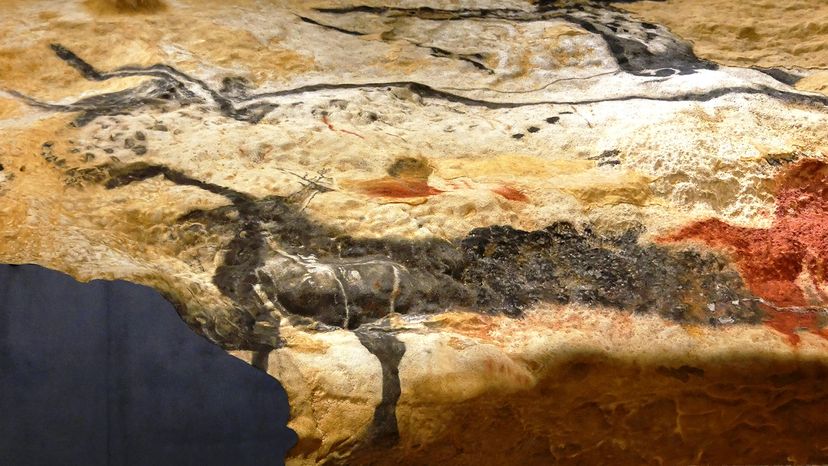
The animals are depicted in prehistoric art such as the cave paintings in the Lascaux caves of France. Neolithic petroglyphs, Bronze Age figurines and ancient reliefs in Egypt and Mesopotamia also show the powerful wild cattle.

Advertisement

In ancient cultures the aurochs symbolized strength, virility, and status. Aurochs horns were sometimes used as drinking horns, ceremonial objects, or trophies.

Historical texts also reference the animal. Julius Caesar described aurochs as extremely fast and powerful animals, praising hunters who managed to kill one.

These animals were so culturally significant that they appear in myths and literature, including the medieval German epic known as the Nibelungenlied.

Advertisement

Domestication and the Rise of Cattle

The domestication of wild aurochs transformed human society. Early farmers in the Near East began managing herds of these animals roughly 10,000 years ago.

Domesticated cattle provided meat, leather, milk, and traction for agriculture. This transition allowed human populations to move from purely hunting and gathering toward farming and permanent settlements.

Advertisement

Over time domesticated cattle spread across Europe, Asia and Africa. Selective breeding produced the many cattle breeds seen today, including dairy cattle and hardy grazing breeds such as highland cattle.

Even though modern cattle are generally smaller and more docile, they remain descendants of wild aurochs.

Advertisement

The Extinction of the Aurochs

Despite their adaptability, aurochs populations gradually declined. Habitat loss, habitat fragmentation, and heavy hunting pressure reduced their numbers across Europe and western Asia.

As agriculture expanded, forests and wetlands that once supported wild cattle were converted into farmland. The species' range shrank steadily over time.

Advertisement

The last surviving population of European aurochs lived in the Jaktorów Forest in Poland. The final known animal, a cow, died there in 1627.

With that death, the aurochs officially became an extinct species.

Advertisement

Rewilding and the Search for Aurochs-Like Cattle

Although the original wild species is gone, scientists and conservationists are exploring ways to restore the ecological role once played by aurochs.

Large herbivores like the aurochs were considered keystone species because their grazing shaped natural ecosystems. By feeding on grasses and shrubs, the animals helped maintain open landscapes that supported many species of plants, insects and birds.

Advertisement

Modern rewilding projects attempt to recreate this ecological function. Programs such as the Tauros Programme use selective breeding to produce cattle with traits similar to the extinct aurochs.

We created this article in conjunction with AI technology, then made sure it was fact-checked and edited by a HowStuffWorks editor.

Advertisement

Advertisement

Loading...