Dunkleosteus: A 20-Foot Fish With an Armored Skull and Bladed Jaws

By: Nico Avelle  | 
fossil
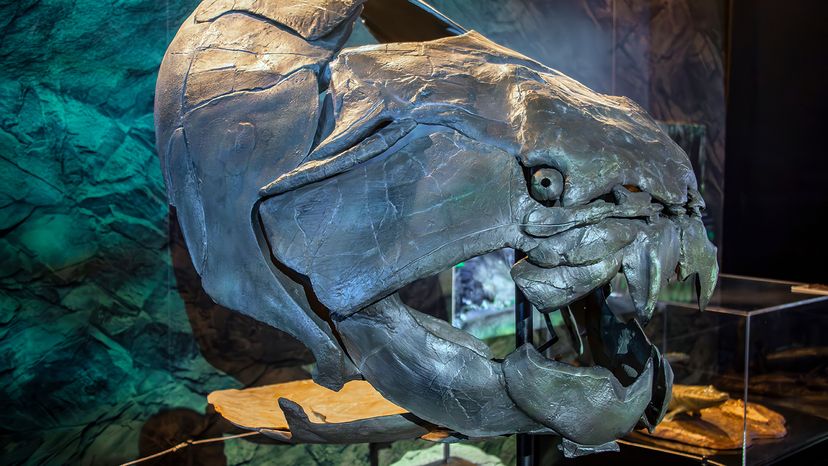
This partial model of Dunkleosteus terrelli looks like a graboid straight out of the movie "Tremors." Danny Ye / Shutterstock

Dunkleosteus was one of the most formidable predators in ancient oceans. This armored fish lived in marine ecosystems during the Late Devonian period roughly 360 million years ago.

Scientists study Dunkleosteus fossils and fragmentary remains to understand how this extinct fish lived and hunted. Many Dunkleosteus specimens consist mostly of armored skull plates and jaws, and those fossils provide powerful clues about body shape, feeding habits, and life in Devonian seas.

Advertisement

Many world famous specimens come from the Cleveland Shale near Lake Erie in northeast Ohio. Researchers from the Cleveland Museum of Natural History have studied these Late Devonian rock units for more than a century, helping reconstruct one of the most iconic predators in vertebrate paleontology.

Dunkleosteus terrelli and Its Famous Fossils

The best known species is Dunkleosteus terrelli. Most Dunkleosteus fossils discovered in the Cleveland Shale include skull armor, upper and lower jaws, and thick bony plates that protected the head and thorax.

These Dunkleosteus remains were preserved in Late Devonian strata that formed when much of North America sat beneath a shallow sea. Fossil material found around the Rocky River Reservation near Lake Erie helped establish the species as a classic example of armored fish from the Devonian period.

Advertisement

The Cleveland Museum of Natural History houses several world famous specimens. Museum curator teams and vertebrate paleontology researchers continue to analyze fragmentary remains and sparse preserved fin elements to improve life reconstruction models of the animal alive.

Body Armor, Bladed Jaws and Bite Force

Dunkleosteus belonged to a group of armored fish called placoderms. These early vertebrates had heavy body armor made of interlocking bony plates that protected the head and thorax.

The jaws of Dunkleosteus terrelli formed sharp bony blades rather than teeth. These bladed jaws acted like self-sharpening shears capable of slicing through other fish and piercing thick-shelled ammonites.

Advertisement

Biomechanics research suggests Dunkleosteus had an enormous bite force combined with an extremely fast jaw opening mechanism. The upper and lower jaws snapped shut with tremendous power.

Dunkleosteus Size, Body Plans and Swimming

Scientists still debate Dunkleosteus size. Some length estimates suggest the largest Dunkleosteus measured about 20 feet (6 meters) long, though earlier reconstructions sometimes exaggerated size estimates.

Recent studies based on body plans of related placoderms suggest the animal likely had a relatively stout, deep trunk and a caudal fin suited for pelagic swimming. This pelagic swimming style may have resembled that of modern fishes such as large pelagic sharks.

Advertisement

Because Dunkleosteus fossils rarely preserve the full skeleton, scientists rely on comparisons with other placoderms and living fishes to estimate body shape. These comparisons help explain how such armored fish could still move efficiently through open water.

External research continues to refine these reconstructions.

Advertisement

Life in Late Devonian Marine Ecosystems

Dunkleosteus lived during a time when many marine ecosystems flourished across shallow seas. Other placoderms, early sharks and numerous fossil fish shared these waters.

As a massive apex predator, Dunkleosteus likely ate other fish and smaller armored species. Its feeding habits allowed it to fill ecological roles similar to those of pelagic sharks in modern marine ecosystems.

Advertisement

However, extinction events occurred near the end of the Devonian period. Environmental shifts disrupted marine ecosystems across the world and many armored fish groups disappeared.

Today Dunkleosteus remains one of the most recognizable examples of prehistoric life from the Late Devonian. Even with sparse and fragmentary remains, the terrible fish continues to help scientists understand early vertebrates and the evolution of powerful ocean predators.

We created this article in conjunction with AI technology, then made sure it was fact-checked and edited by a HowStuffWorks editor.

Advertisement

Advertisement

Loading...