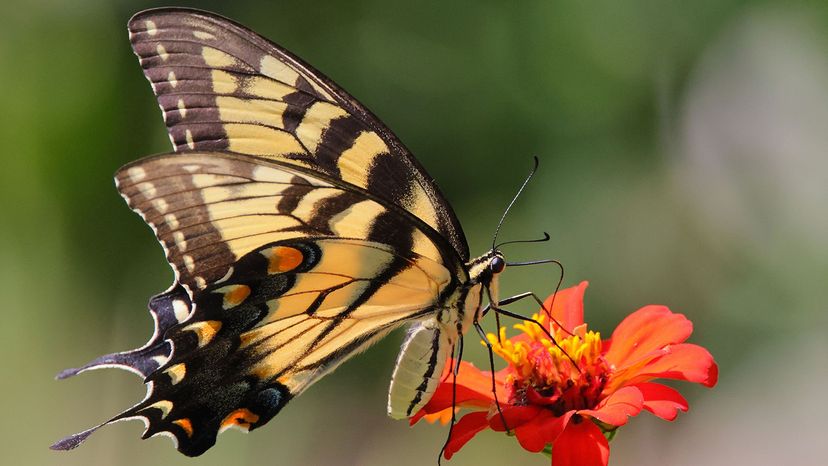
A Very Special Yellow Butterfly: The Eastern Tiger Swallowtail

By: Nico Avelle  | 
Eastern tiger swallowtail butterfly
Males like this one will sport colors that attract a mate, whereas females are colored to deter predators. Wirestock Creators / Shutterstock

The yellow butterfly gives other insects a masterclass in adaptation, camouflage and transformation. One yellow butterfly in particular stands out: the eastern tiger swallowtail.

With its black stripes and wide wingspan, the eastern tiger swallowtail (Papilio glaucus) is one of the most easily recognized butterflies in the eastern United States. It's commonly found from southern Florida to the Canadian border, fluttering through woodlands, gardens and meadows.

Advertisement

Males flash bold black stripes on their yellow forewings, while females come in both yellow and dark brown forms, possibly mimicking poisonous species to fool predators.
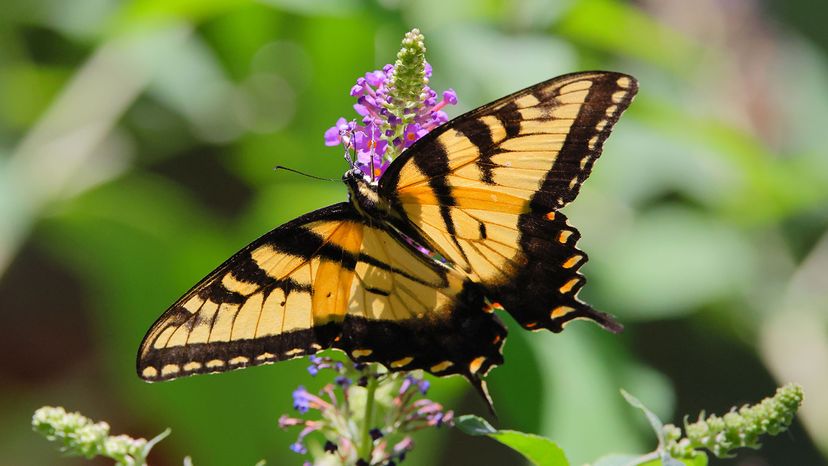
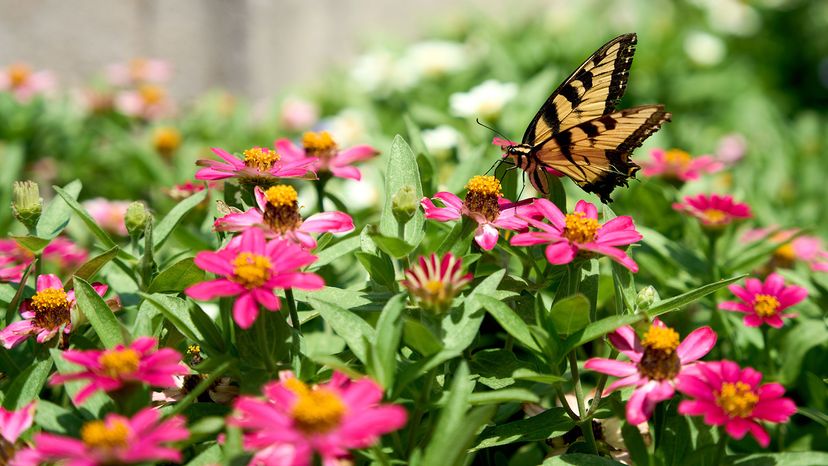
What Makes the Eastern Tiger Swallowtail So Distinctive?

This large yellow butterfly boasts a wingspan ranging from 3.1 to 5.5 in (7.9 to 14 cm). Its upper surface gleams yellow with black tiger-like stripes, while the hind wings display blue and orange spots near the outer edge. A bold black border traces the edge of the wings, completing its unmistakable look.

Females tend to have more blue on their hind wings, which may act as a warning sign to predators. This type of mimicry is called Batesian mimicry, and it's a survival tactic that helps nontoxic butterflies avoid being eaten.

Advertisement

You can often see these butterflies resting with wings open, revealing contrasting patterns that serve as a warning to predators, rather than hiding with camouflage.

Habitat, Range and Behavior

eastern tiger swallowtail
Eastern tiger swallowtails thrive in gardens and meadows. Wirestock Creators / Shutterstock

Native to North America, the eastern tiger swallowtail has a vast range. It is commonly found across the eastern United States, stretching north into Canada and south into southern Florida.

These butterflies thrive in habitats that include wood edges, gardens, parks, and meadows. They are also observed along roadsides and near wild flowers, especially where nectar sources are abundant.

Advertisement

In northern regions, the eastern tiger swallowtail usually produces two generations per year. In the southern United States, like Georgia and Florida, they may complete two to three broods annually depending on weather conditions.

These butterflies are frequently seen during spring, summer and early fall.

Advertisement

From Egg to Adult: Lifecycle Stages

The lifecycle of the eastern tiger swallowtail follows the standard four-stage metamorphosis of butterflies: egg, larva, pupa and adult.

Eggs are laid singly on host plants such as tulip poplar (Liriodendron tulipifera), ash, sweetbay magnolia and wild cherry. Gardeners may spot the tiny eggs on the upper surface of leaves.

Advertisement

The larva, or caterpillar, begins as a small brown organism resembling bird droppings, which helps it avoid predators. As it grows, it turns green with false eye spots on its thorax to further deter threats. It eventually attaches itself to a leaf or twig using a silk pad and girdle, where it enters the chrysalis stage.

Depending on the time of year, the pupa may overwinter or transform into an adult butterfly in a matter of weeks. In colder regions, the chrysalis waits out winter before proceeding to complete metamorphosis.

Advertisement

Feeding Habits and Survival Tactics

Adult butterflies feed on nectar from a variety of wild and garden flowers including milkweed, phlox, Joe-Pye weed and coneflowers.

In addition to nectar, males are often seen puddling—gathering nutrients from damp ground, carrion and animal droppings. This behavior supplements their diet with salts and amino acids.

Advertisement

Caterpillars feed voraciously on the leaves of host plants, storing up energy for their transformation. The larva's ability to switch from brown to green helps it stay concealed during different growth stages, making it less appealing to birds and other predators.

Gender Differences and Mimicry

Eastern tiger swallowtail butterfly
Males of this species have bright yellow wings with black and yellow spots. Wirestock Creators / Shutterstock

Males and females of the species can look quite different. Males are typically bright yellow with bold black stripes.

Females may exhibit two forms: the yellow morph similar to males, and a darker morph with brown or nearly black wings and blue spots. This variation is more common in southern populations, particularly in the southeastern U.S.

Advertisement

The dark morph may mimic the pipevine swallowtail, a poisonous species, to gain protection—another mimicry trick. This evolutionary adaptation helps tiger swallowtails avoid predation despite not being toxic themselves.

Gardeners' Guide to Attracting Yellow Butterflies

If you want to attract eastern tiger swallowtails to your garden, consider planting native nectar sources and host plants. Tulip poplar, wild cherry and sweetbay magnolia make excellent choices for laying eggs.

For feeding adults, choose flowering plants that bloom across multiple seasons.

Advertisement

Butterfly bush, bee balm and milkweed are commonly recommended by experts and loved by butterflies. Providing a small area of damp soil or sand can also support puddling behavior.

Avoid pesticides and maintain a wild area to create a safe haven.

We created this article in conjunction with AI technology, then made sure it was fact-checked and edited by a HowStuffWorks editor.

Advertisement

Advertisement

Loading...