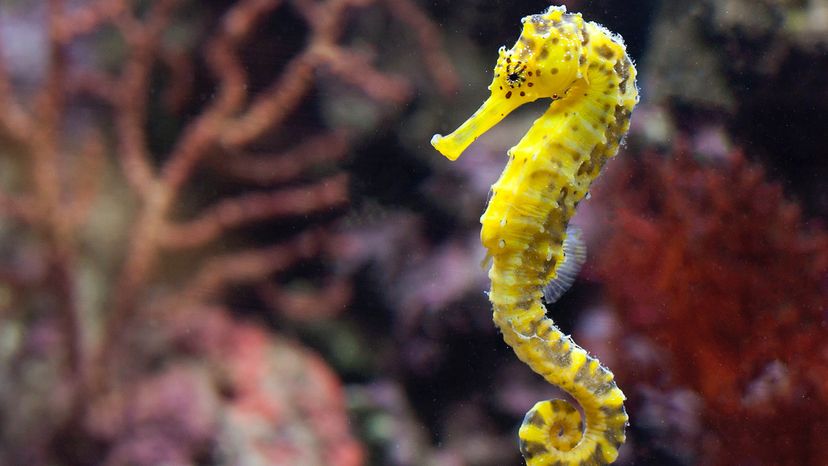
This yellow seahorse will use its tail to anchor itself while avoiding predators or eating. Androz Zen / 500px / Getty Images/500px
Is a seahorse a fish? Yes, despite their oddball appearances, seahorses are indeed fish. They belong to the genus Hippocampus and are classified within the Syngnathidae family, which also includes pipefish and sea dragons.
Like other fish, they have gills, a swim bladder, and fins—even if their small pectoral fins and upright posture make them look more like animated chess pieces than typical fish.
Advertisement
Seahorses evolved to thrive in specific marine habitats, from coral reefs to shallow seagrass beds in temperate and tropical waters.
There are over 45 known seahorse species, including the spiny seahorse, short snouted seahorse, common seahorse, long-snout seahorse, and Pacific seahorse (Hippocampus ingens).
Each has adaptations that help them survive in different ecosystems, often as stationary as a rock but ready to suck up small crustaceans and brine shrimp with their tube-like snouts.
Advertisement
Why Are Seahorses Considered Fish?
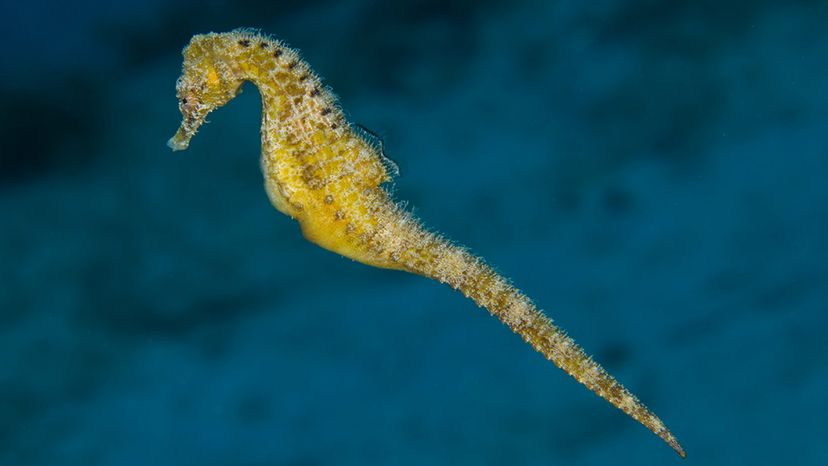
Fish are aquatic vertebrates with gills and fins—and seahorses check all those boxes. Though they're poor swimmers, seahorses rely on their dorsal fin for propulsion and pectoral fins near the head for steering.
They don’t have scales like most other fish; instead, their bodies are covered in bony plates arranged in rings. These armored exteriors help protect them from predators.
Advertisement
Their swim bladders help control buoyancy, just like other bony fish. Even the Knysna seahorse, one of the smallest and rarest species found only in South Africa, is biologically a fish.
Though not built like typical fish, seahorses meet all anatomical criteria. Their long snout, upright posture, and fused jaws may look bizarre, but their membership in the fish family is well established.
Advertisement
How Seahorse Reproduction Flips the Script
In seahorse species, the male carries the fertilized eggs to term and gives birth. Charlotte Bleijenberg / Getty Images/iStockphoto
In most bony fish species, females lay eggs and males fertilize them externally. Seahorses turn this on its head: The female seahorse deposits her eggs directly into the male's pouch, called a brood pouch. Inside, the male fertilizes the eggs and incubates them throughout the reproductive cycle.
When fully developed, the male seahorse goes into labor—yes, giving birth to dozens or even hundreds of baby seahorses. In many species, this process can result in the release of hundreds of young.
Advertisement
Notably, Hippocampus whitei (White's seahorse) and Hippocampus guttulatus (long-snouted seahorse) exhibit especially complex brood pouch systems.
These structures regulate salinity and provide oxygen—much like a mammalian placenta—to support the female's eggs.
This role reversal is one reason why male and female seahorses are often studied together. Their interactions highlight a different model of parenting among marine animals, unlike what we see in other fish.
Advertisement
Anatomy Suited for Anchored Living
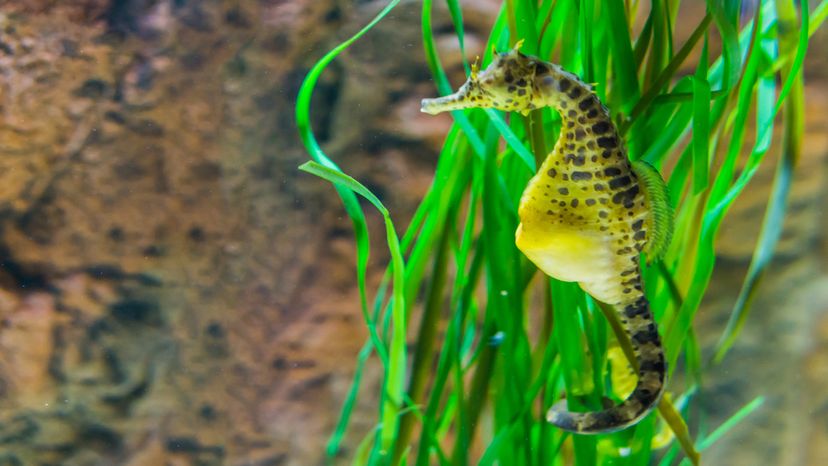
Seahorses have a prehensile tail that allows them to cling to stationary objects like seagrasses, sponges, and coral. This is vital for survival in high-flow environments.
The yellow seahorse (Hippocampus kuda), for instance, uses this tail to anchor itself in tropical waters while feeding or avoiding predators.
Advertisement
Despite being poor swimmers, seahorses are adept hunters. They typically rely on camouflage and patience rather than pursuit to find food. Their long snout acts like a straw to suck up brine shrimp, small crustaceans, and other microfauna.
Their small pectoral fins allow for subtle steering, while their dorsal fin flutters rapidly to maintain position. Combined with bony plates and fused jaws, these features make them highly specialized but unmistakably bony fish.
Advertisement
A Taxonomical Tour Through Seahorse Diversity
These species of seahorse vary in size, habitat, and behavior, but all belong to the Syngnathidae family. Most prefer shallow waters, often near coral reefs, where camouflage and anchoring are essential to survival.
Hippocampus erectus: Lined seahorse, common in western Atlantic
Hippocampus ingens: Among the largest seahorses, also called the Pacific seahorse
Hippocampus kuda: Widespread in Indo-Pacific, also known as the yellow seahorse
Hippocampus whitei: Native to eastern Australia
Hippocampus zosterae: A smaller species found in the Gulf of Mexico
Hippocampus guttulatus: Known for its long snout and found in European waters
The spiny seahorse and short-snouted seahorse are also found throughout European waters.
Advertisement
Evolution and Natural History
Seahorses have evolved to take advantage of spaces where other fish can't fit. Sakis Lazarides / Getty Images
The natural history of seahorses traces back to the middle Miocene, about 13 million years ago. Fossil records show early species with many of the same traits seen today, including upright bodies and elongated snouts.
Seahorses are closely related to pipefish and trumpetfish. Seahorses and pipefish share fused jaws and bony body rings, whereas trumpetfish lack this extensive body armor.
Advertisement
As seahorses evolved, their unique shape and reproductive strategies helped them fill niches that other fish species couldn’t. This evolutionary divergence explains how they can look so different from typical fish yet remain firmly within the classification of fish.
Conservation and Human Impact
Due to habitat degradation and overfishing, many seahorse populations are in decline. While two species might thrive in one region, others may be on the brink due to pollution, coral bleaching, and harvesting for traditional medicine.
Human activities such as coastal development and trawling often damage vital seahorse habitats like coral reefs and shallow waters. Conservation efforts are underway to monitor many species, restrict trade, and establish marine protected areas.
Advertisement
The vulnerability of seahorses has made them flagship species for ocean conservation. Protecting their habitats benefits a wide range of marine biology interests, from reef health to sustainable fishing.
We created this article in conjunction with AI technology, then made sure it was fact-checked and edited by a HowStuffWorks editor.
Advertisement
Cite This!
Please copy/paste the following text to properly cite this HowStuffWorks.com article: