What Is a Group of Fish Called? Not Always a School

By: Nico Avelle  | 
If you see a gathering of mixed-species fish like this, it's not a school. It's a shoal. Damsea / Shutterstock

A group of fish swimming together is usually called a school or a shoal, but these terms aren't interchangeable.

If the fish are all the same species and moving in a coordinated manner, it's a school. If they're simply hanging out together for social reasons or safety, it's a shoal.

Advertisement

About half of all fish species shoal at some point in their lives. About one quarter of fish species shoal for their entire lives, while roughly one half shoal only for part of their lives. A single fish often seeks out a social group to help them find food, avoid larger predators, and reduce swimming costs.
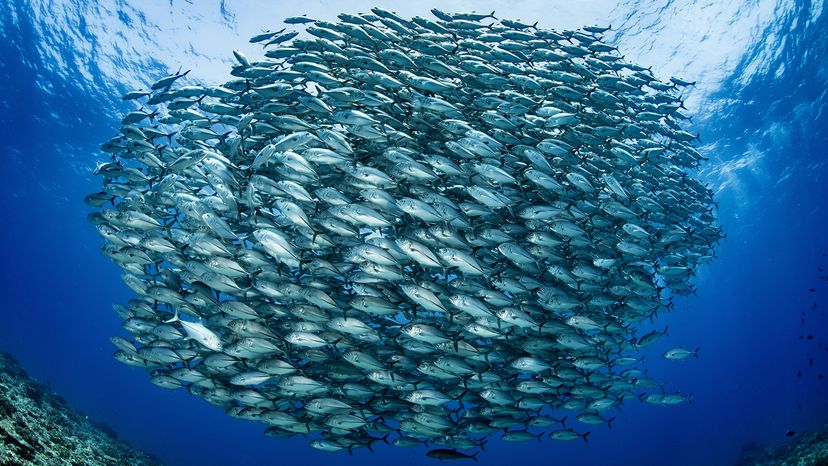
What Is a School of Fish?

fish
Sometimes fish will form a bait ball when under attack. Earth theater / Shutterstock

A school is a tight, synchronized group of fish swimming at the same speed and in the same direction. This isn't a random gathering. It's a coordinated form, often involving one fish species, where each fish moves in concert with the others.

This behavior helps with predator avoidance. Schooling fish can confuse predators like sharks or swordfish, making it hard to target just one. A bait ball—a dense, spinning sphere of fish—can even form when under attack.

Advertisement

Most schools include fish of the same size and species. That uniformity keeps the rhythm tight. If one fish stops or swims differently, it disrupts the whole formation.

What Is a Shoal of Fish?

A shoal is more relaxed than a school. It's a social group of fish that may include multiple species. These fish aren't necessarily swimming in the same direction or speed; they're just together.

Shoaling happens for many reasons: finding food, seeking nesting sites, or just social interaction. It makes sense when fish want the benefits of a group without the demands of strict coordination.

Advertisement

Some shoals contain only a few individuals, while others have many fish. It's common to see a shoal transition into a school if danger appears.

How Fish School

fish
Vibrations and changes in pressure help fish coordinate in schools. toshiharu_arakawa / Shutterstock

Fish coordinate using a sensory system called the lateral line. It detects pressure changes and vibrations in the water. That allows fish to react quickly to neighbors and swim as a unit.

Schooling behavior reduces drag and energy expenditure. By drafting behind others, fish in a school glide more efficiently through water currents. It's the aquatic version of cyclists drafting in a race.

Advertisement

Social learning also plays a role. Fish copy the movements of others, especially experienced members. This lets the group respond instantly to changes in the environment.

Can Different Fish Species Form a School?

While most schools consist of the same species, there are exceptions. Under certain conditions—like predator attacks or abundant food—different species may school together.

These mixed-species schools are temporary and often form near coral reefs or during feeding events. But in general, fish prefer to school with their own kind. A lone fish or one moving at a different speed can disrupt the group's coordination.

Advertisement

Shoals, on the other hand, are more open. It's not unusual to see a shoal with rainbow fish, sardines, or other species mixed in. They're united by a shared purpose, not identical DNA.

Why Do Fish Group Together?

Grouping up has big perks. For small fish, being in a school means safety from predators. The swirling motion of many fish moving together creates confusion and reduces the risk of any one fish being caught.

There's also strength in numbers when it comes to food. Social groups find and exploit resources faster. Fish called scavengers may follow these groups to benefit.

Advertisement

Then there's the benefit of communication. Many fish use subtle movements to relay information. It's like an aquatic Facebook account: Everyone stays updated.

Do All Fish Form Groups?

Not all fish group up. Some large species, like the Humboldt squid or salmon, are more solitary. Others school only when young.

Some fish stop schooling as they mature or during nesting. A few individuals always go against the flow. But for most species, schooling behavior is essential.

Advertisement

Scuba diving in the ocean or observing an aquarium offers clear examples. You'll often see small groups form and dissolve based on feeding, mating, or the presence of other predators.

Other Collective Nouns for Animals

"School of fish" is a well-known collective noun, but it's not the only one. Other animals have colorful group names too. A group of crows is a murder. A group of sharks is a shiver. And a group of manta rays? That’s a squadron.

We created this article in conjunction with AI technology, then made sure it was fact-checked and edited by a HowStuffWorks editor.

Advertisement

Advertisement

Loading...