The Smallest Bat in the World Is the Size of a Bumblebee

By: Nico Avelle  | 
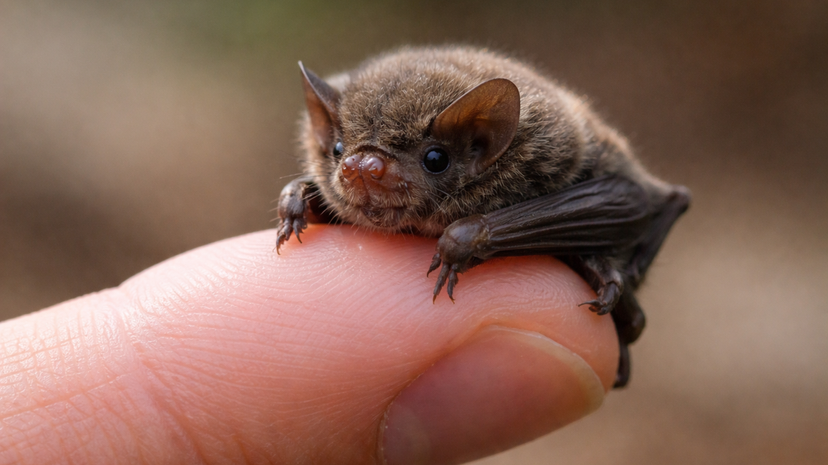
Kitti's hog-nosed bat is the smallest species of its kind. Nicole Antonio / DALL-E

The smallest bat in the world is so tiny it can easily fit on the tip of a human finger. Known commonly as the bumblebee bat, this remarkable animal weighs about as much as a small coin and is often compared to a large bumblebee in size.

Scientists call the species Craseonycteris thonglongyai, though many people know it as Kitti's hog-nosed bat. Despite its tiny body, this bat plays an important role in the ecosystems where it lives.

Advertisement

Understanding the world's smallest bat offers a fascinating look at the diversity of bats and the ecological roles these flying mammals play.

What Is the Smallest Bat in the World?

The smallest bat species ever discovered is Kitti's hog-nosed bat (Craseonycteris thonglongyai). It is widely recognized as the world's smallest bat and is often considered the world's smallest mammal by body length.

Adult individuals measure roughly 1.1 to 1.3 in (29 to 33 mm) in body length and weigh about 0.071 oz (2 g). That tiny body weight makes the animal comparable in mass to a large bumblebee, which explains its common name: the bumblebee bat.

Advertisement

The bat also has distinctive features. Its head includes a pig-like snout, large ears and very small eyes that are partly hidden by fur.

The species was first described in 1974, and the species name honors Thai zoologist Kitti Thonglongya.

Advertisement

Where the Bumblebee Bat Lives

The natural habitat of the bumblebee bat is extremely limited. These tiny bats live in limestone caves along rivers in western Thailand and nearby areas of southeast Myanmar.

Most known colonies occur in caves near the Khwae Noi River in Thailand. A smaller Myanmar population exists across the border, though the groups are separated enough that there is no gene flow between them.

Advertisement

Within these caves, the bats roost high on the walls or on the ceilings of dome-shaped chambers, often far from cave entrances. Colonies are relatively small, usually averaging around 100 individuals.

Because their habitat is restricted to a few cave systems in a small geographic region, scientists consider the species particularly vulnerable to environmental changes.

Advertisement

How the World's Smallest Bat Hunts

Despite its tiny size, the bumblebee bat is an efficient hunter. Like other bats, it uses echolocation to locate prey in the dark.

These bats feed primarily on small flying insects, especially flies. Their diet can also include spiders and other small arthropods.

Advertisement

The animals typically forage during short activity periods at dusk and again near dawn. During these brief hunting flights, they dart through forested areas near their caves to catch insects in midair.

Their small size allows them to move quickly while hunting, making them effective predators of tiny insects.

Advertisement

Why Bats Matter to Ecosystems

Bats play a major role in ecosystems worldwide. Many species are insectivores that help control insect populations, including agricultural pests and insects that spread disease.

By consuming large numbers of insects each night, bats contribute to ecosystem balance and help protect crops. In addition, other bat species pollinate plants and disperse seeds, supporting forest growth and plant reproduction.

Advertisement

There are more than 1,400 species of bats worldwide. They range dramatically in size, from the tiny bumblebee bat to giant flying foxes with wingspans reaching up to about 5.6 ft (1.7 m).

Bats live across most of the planet—including deserts—but not in polar regions.

Advertisement

Threats Facing the Bumblebee Bat

Because of its limited habitat, the bumblebee bat faces several conservation challenges. Deforestation and habitat loss near cave systems can disrupt both roosting sites and feeding areas.

Human tourism in caves can also disturb colonies. Even small disruptions can affect bats because the colonies are relatively small.

Advertisement

The International Union for Conservation of Nature (IUCN) currently lists Kitti's hog-nosed bat as "near threatened" due to habitat degradation and its restricted geographic range.

Conservation efforts focus on protecting limestone caves, nearby forests, and the surrounding ecosystems that support the insects these bats depend on.

Advertisement

Life Cycle of the Tiny Bat

Like many bat species, the bumblebee bat reproduces slowly. Females typically give birth once per year and usually produce a single offspring.

The young bat clings to its mother in the roost during early development until it can fly and hunt on its own. This slow reproductive rate means populations can take a long time to recover if numbers decline.

Advertisement

Protecting their habitat is therefore critical to ensuring the survival of the world's smallest bat.

We created this article in conjunction with AI technology, then made sure it was fact-checked and edited by a HowStuffWorks editor.

Advertisement

Advertisement

Loading...