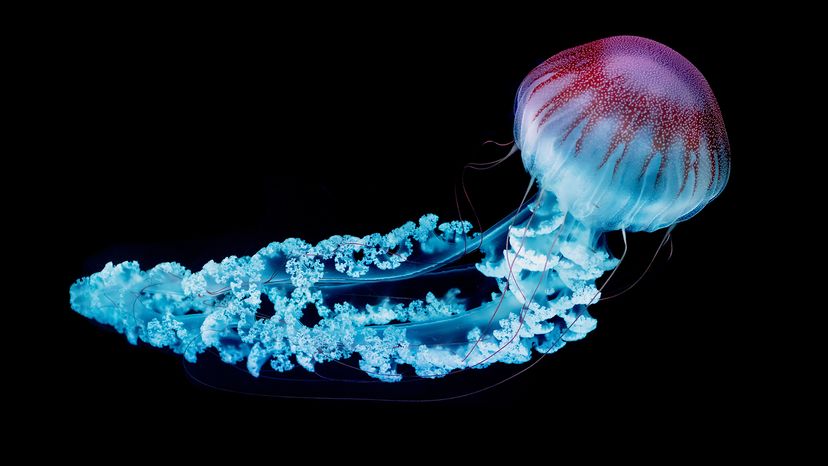
Deep Sea Jellyfish Have 30-foot-long Tentacles

By: Nico Avelle  | 
Some jellyfish live in a part of the ocean that's so deep and dark, it's called the midnight zone. krcil / Shutterstock

In the deepest, darkest parts of the ocean, far below where visible light can reach, swims one of the strangest animals on Earth: the deep sea jellyfish. These mysterious creatures thrive in a zone so dark and pressurized it's nicknamed the midnight zone.

Unlike their shallow-water cousins, deep sea jellyfish are adapted to extreme conditions.

Advertisement

They drift silently through the ocean depths, often glowing with bioluminescence, a light show powered by chemistry. These flashes help attract prey or confuse predators in a place where sunlight never penetrates.

What Is the Giant Phantom Jellyfish?

One of the largest and rarest deep sea jellyfish is the giant phantom jellyfish, or Stygiomedusa gigantea. With a bell that can stretch over 3 ft (1 m) wide and four long, ribbon-like arms reaching up to 33 ft (10 m), this animal moves with eerie grace.

It was first discovered in 1899 and has only been observed around 120 times since then, mostly via deep-sea submersible footage.

Advertisement

Giant phantom jellies have no stinging tentacles. Instead, they use their massive arms to catch prey like plankton and small fish. Scientists think they might also host other species—such as the pelagic brotula, which shelters under their bells and may help by removing parasites.

Where Do Deep Sea Jellyfish Live?

These jellies are found worldwide, from the Gulf of California to waters near the Antarctic Peninsula, but are absent from the Arctic Ocean. They glide through the deep ocean and have been recorded at depths from the surface down to about 22,000 ft (6,700 m).

That puts them well below the reach of most research equipment, making direct observations rare.

Advertisement

Researchers rely on footage from remotely operated vehicles (ROVs) to study their behavior and ecology. Most of what we know about their development and physiology comes from a handful of collected specimens and hours of deep-sea video review.

Why Are Deep Sea Jellies Important?

Deep sea jellyfish like Stygiomedusa gigantea are crucial to understanding marine ecosystems.

As some of the largest invertebrate predators in the ocean, they help shape food webs in ways scientists are just beginning to understand. Jellyfish populations can reflect changes in ocean conditions, often thriving as climate change warms the seas and reduces oxygen levels.

Advertisement

Recent expeditions have brought in more data, images, and videos to help scientists better understand this elusive species. But much remains unknown, including how long they live, how they reproduce, and how abundant they are.

We created this article in conjunction with AI technology, then made sure it was fact-checked and edited by a HowStuffWorks editor.

Advertisement

Advertisement

Loading...