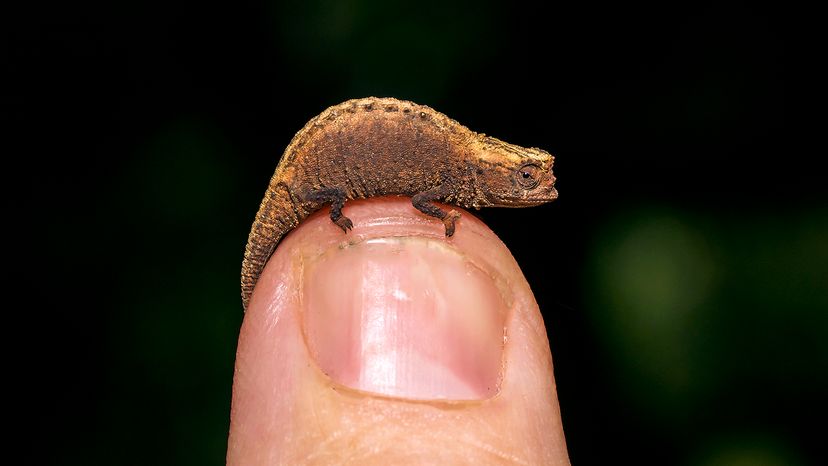
The cleanest way to rank a lizard species is by SVL, not by total length. A long tail can make one lizard look bigger on paper even when its body is smaller, so researchers focus on the body first and then add tail measurements for context.
That is why Sphaerodactylus ariasae remains such an important benchmark. This dwarf gecko is one of the smallest species in the family Sphaerodactylidae, and adults measure about 14 to 18 mm from the snout to the base of the tail. That is roughly 0.55 to 0.71 inches, and the average weight is only 0.13 grams.
In older coverage and natural history discussions, it was often treated as the world's smallest lizard, and it is still one of the smallest geckos ever described.
The nano chameleon changed the conversation. In 2021, researchers led by Frank Glaw, with scientists including Oliver Hawlitschek and Miguel Vences, formally described Brookesia nana from northern Madagascar in Scientific Reports.
The species is a tiny lizard with a body length so short that it is now commonly called the world's smallest lizard. Because it is also a chameleon, its discovery expanded the record beyond the dwarf gecko group.
Other species still belong in the story. The Jaragua dwarf gecko's close company includes the Virgin Islands dwarf gecko, Sphaerodactylus parthenopion, from the British Virgin Islands, long treated as one of the smallest lizard species and about 0.7 inches (18 mm) long from the snout to the vent.
Even beyond these record holders, there are many small species. The Lesser Earless Lizard, Holbrookia maculata, averages about 2 inches (5.1 cm) in snout-vent length, while the Greater Short-horned Lizard, Phrynosoma hernandesi, usually measures about 2.0 to 2.7 inches (5.2 to 6.9 cm) in SVL and has a rounded, flattened body.