11 Animals that Use Camouflage

Timothy G. Laman/National Geographic/Getty Images
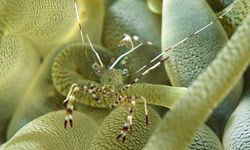
Can you find the small shrimp hiding among the stinging tentacles of a sea anemone? See more pictures of animal camouflage.
The animal kingdom is a wild, wacky place where animals have to be clever in order to survive. One of the most amazing techniques for survival is animal camouflage. Animals have the ability to mimic plants, ground cover, or even other animals in order to hide or hunt. The following is a list of some animals that are particularly gifted in the art of invisibility.
1. Chameleons
Contrary to popular belief, chameleons only change color when in imminent danger. Their everyday skin color, a light khaki, keeps them hidden from enemies during those not-so-dangerous times. Nearly half the world's chameleon species live in Madagascar, but they're also found in Africa, the Middle East, and southern Europe.
2. Leopards
Whether their coats are spotted (useful for
hiding in sun-dappled areas in the African outback) or black (perfect
for nighttime stalking or lurking in shadows), these elegant and deadly
cats are born with fashionable camouflage. Rabbits, young buffalo, and
monkeys don't stand a chance when a hidden leopard makes a surprise
attack.
3. Polar Bears
Other bears and human
poachers are the biggest threats to the majestic polar bear, but by
blending into the blindingly white snow of the Arctic with equally
white fur coats, some danger can be avoided. Only a polar bear's nose
and foot pads are without fur.
4. Turtles
If
you're a fish, you better look twice before resting near that big rock
. . . it could be an snapping turtle. There are hundreds of species of
turtles and tortoises that use camouflage to blindside their prey and
hide from large predators like alligators. Sadly, camouflage can't
protect turtles from the poacher's fishnet.
Sure, chameleons
are well-known to change color and blend into surroundings, but some of
the animals who use camouflage on the next few pages may surprise you.
5. Arctic Owls
Ah, the Arctic tundra: cold, barren, and totally white. Arctic owls have a coat of snow-white feathers to keep them warm and safe from predators, such as foxes and wolves.
6. Bark Bugs
For
most bugs, birds are the bad guys. For bark bugs, which hang out on
trees around the world, this is especially true. In order to hide in
the middle of nature's birdhouses, bark bugs appear to be part of the
tree itself.
7. Ornate Wobbegongs
If
you're ever swimming in the shallow waters off Australia or New Guinea,
look for the ornate wobbegong -- though you probably won't be able to
see it! This shark's body flattens out on the seafloor where its spots
and blotchy lines resemble rock and coral. Wobbegongs take camouflage a
step further with a little "beard" under their chins that looks like
seaweed. Prey that swim in front of their mouths are gobbled up without
knowing what hit them.
8. Gaboon Vipers
In
order to hide from their prey, gaboon vipers -- among the most venomous
snakes on Earth -- make the most of their brownish-gray, mottled
scales. These big snakes hide in the layer of dead leaves that carpets
the African rain forest floors. They also like to snuggle into forest
floor peat and sneak up on unsuspecting prey.
9. Leaf Butterflies
Complete
with fake leaf stalk, fake leaf veins, and perfect dead-leaf coloring,
leaf butterflies have the whole camouflage thing down pat. Birds pass
them by without a second glance since these insects from southeast Asia
look more like dead leaves than butterflies.
10. Dragon Lizards
Spiders,
snakes, birds, and even other lizards all want a piece of the dragon
lizard, so they have some of the most effective camouflage around. Not
only do dragon lizards look nearly invisible when hanging out on a tree
branch, they keep extraordinarily still, knowing that their predators
react to the smallest movements. It doesn't make for an exciting life,
but at least they live to tell about it.
11. Flower Mantises
Careful-- that flower you're thinking about smelling might have a flower
mantis hiding inside. The flower mantis of western Africa uses
colorful, pistil-and-stamen-like camouflage to trick smaller insects
into smelling the roses, then snap -- lunch is served.
CONTRIBUTING WRITERS:
Helen Davies, Marjorie Dorfman, Mary Fons, Deborah Hawkins, Martin Hintz, Linnea Lundgren, David Priess, Julia Clark Robinson, Paul Seaburn, Heidi Stevens, and Steve Theunissen
