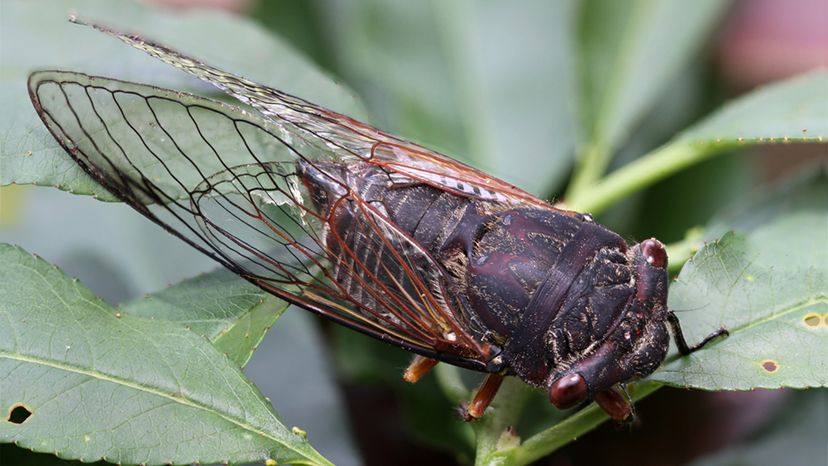
The Black Prince cicada (Psaltoda plaga) is a species native to eastern Australia. This beauty was photographed at Tennyson Point in Sydney. Wikimedia Commons (CC BY 2.0)
Ah — the unmistakable sound of cicadas! Their humming and clicking is certainly one of the most recognizable sounds of summer.
What Are Cicadas?
Cicadas are flying, plant-feeding insects, most famous for their powerful singing voices, which are mainly made up of incredibly loud buzzing and clicking sounds.
Advertisement
Cicada Types
Cicadas belong to a superfamily of insects, the Cicadoidea, which is divided into two families, Tettigarctidae, with two species in Australia, and Cicadidae, the family with more than 3,000 species distributed around the world. These 3,000 species fall into roughly two categories: those that spend most of their lives underground and regularly appear en masse at intervals of 13 or 17 years, and those that show up on a more annual basis.
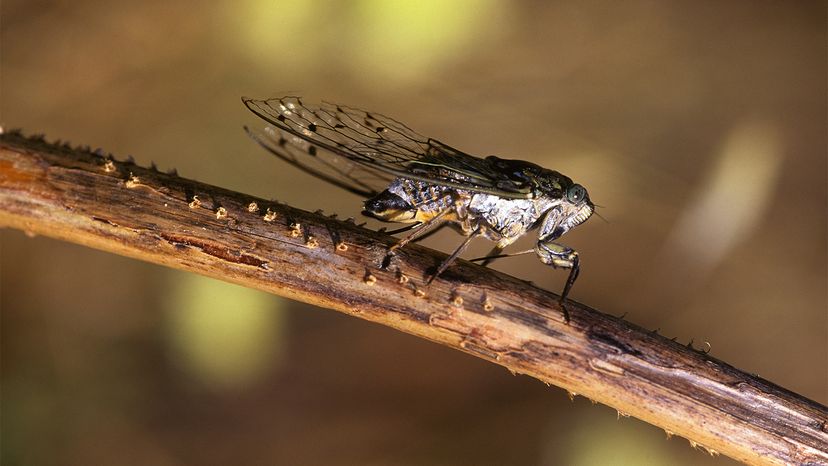
An adult cicada Cicada orni, which is a species of cicada found in southern and central Europe, the Near East and North Africa. Patrick LORNE/Gamma-Rapho/Getty Images
Locust vs Cicada
Cicadas are often mistaken for locusts, but they're actually more like leafhoppers or aphids. They are classified in the order Hemiptera — a distinction given to all insects with piercing and sucking mouthparts [source: Encyclopaedia Britannica].
The average wingspan of a cicada is between 1 and 6 inches (2.5 and 15 centimeters), depending on the type. The periodical variety are notoriously bad flyers, and they often run into things, if they can get off the ground at all. They have four wings, and when they're not flying they fold their wings back along the sides of their body. The glassy, transparent, longer forewing covers the shorter, opaque hindwing. A network of sturdy veins strengthens the two pairs of wings.
Advertisement
Cicadas have three pairs of legs, all about the same length. Consequently, they aren't adept at jumping, though they do try. Large, compound eyes situated on each side of their head give them wide peripheral vision. Three tiny eyes on the top of the head (called ocelli) allow them to watch for predators from above. Small, bristle-like antennae are located just behind the ocelli.
What Do Cicadas Eat?
The cicada's mouthparts are enclosed in a long, thin, beak-like sheath. The sheath, called the labium, is retracted between the legs when the insect is not feeding. The labium contains four needle-like stylets used for feeding. Cicadas feed by piercing the surface of plants with their stylets. They use them like a straw to suck up the sap from plants.
Advertisement
Cicada Sound
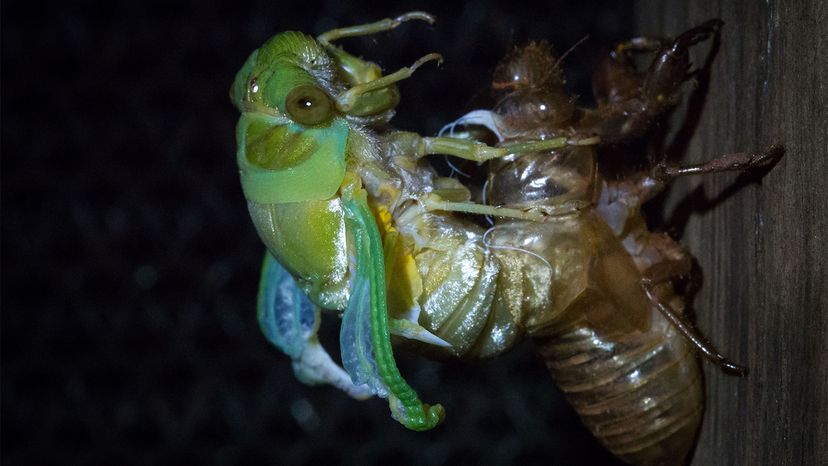
A Greengrocer cicada (cyclochila australasian) stretches its wings after breaking out of its exoskeleton. It is Australia's most recognized and loudest insect.
Brad Leue/Barcroft Media/Getty Images
The cicada's claim to fame (in case you literally haven't heard it) is its singing. The high-pitched song is actually a mating call belted out by males. Each species has its own distinctive song that only attracts females of its own kind. This allows several different species to coexist.
Cicadas are the only insects capable of producing such a unique and loud sound. Some larger species can produce a call in excess of 120 decibels at close range. This is approaching the pain threshold of the human ear! Smaller species sing in such a high pitch that it can't be heard by humans, but your dog will most likely pick it up — and some dogs can even hear the sounds of cicadas tunneling as they prepare to emerge from underground.
Advertisement
The apparatus used by cicadas for singing is complex. The organs that produce sound are called tymbals. This pair of ribbed membranes sits at the base of the abdomen. The cicada sings by contracting the internal tymbal muscles. This causes the membranes to buckle inward, producing a distinct sound. When these muscles relax, the tymbals pop back to their original position. Scientists still don't fully understand how this apparatus produces such extreme volume.
Why Do Cicadas Make Noise?
Cicadas usually sing during the heat of the day. In addition to attracting a mate, the loud noise actually repels birds. The cicada's song is painful to the birds' ears and interferes with their communication, making it difficult for the birds to hunt in groups. Male cicadas in the same brood will stick together when calling in order to increase the total volume of noise. This reduces the chances of bird predation for the whole brood.
Even cicadas must protect themselves from the volume of their own singing. Both male and female cicadas have a pair of large, mirror-like membranes called the tympana, which function as ears. The tympana are connected to an auditory organ by a short tendon. When a male sings, the tendon retracts, creasing the tympana so that it won't be damaged by the sound.
Advertisement
Cicada Eggs
After succumbing to the romantic ballads, the cicadas mate. Afterward, adult female cicadas lay eggs by piercing plant stems with their ovipositor. The ovipositor is an egg-laying spike located at the tip of the female's abdomen. The spike inserts the eggs into the slit created in the stem.
The eggs eventually hatch into small, wingless cicadas known as nymphs. The nymphs fall to the ground and dig below the surface. If they're periodical cicadas, they will stay for 13 or 17 years, slowly growing into adults. The nymphs live on the sap from plant roots while they grow. They shed their skin at intervals throughout their life span.
Advertisement
When the nymphs reach full size, they dig their way to the surface with specially adapted front legs that act as tiny shovels. They surface around nightfall in late spring or early summer. The nymphs then climb to higher ground and shed their skin for the last time. Now fully winged adult cicadas, they leave behind their old, empty, nymphal skin.
Cicada Scrumptious
To some people, cicadas are not just noisy insects, they're also are a low-carb, gluten-free food enjoyed as a delicacy by many cultures around the world.
Cicada Life Cycle
A 17-year periodic cicada (Magicicada sp.), photographed in Lisle, Illinois.
Bruce Marlin, Wikimedia Commons
Do Cicadas Bite?
Even though cicadas may land on you or bump into you, you don't have to worry about getting bitten or stung. Cicadas are harmless. They may cause some slowing of the growth of trees from the amount of sap the cicadas consume, but they won't cause permanent damage. The worst they will do is annoy you with their incessant singing.
How Long Do Cicadas Last?
The life span of an adult cicada is short, as in a few weeks short. As mysteriously as they arrive, they will disappear. Most will be eaten by birds and other predators. Even the nymphs are not safe below the ground, as they're often preyed upon by beetle larvae and other ground-dwelling parasites.
Advertisement
Advertisement
Lots More Information
Sources
Encyclopædia Britannica. Cicada. Encyclopædia Britannica Online Academic Edition. Encyclopædia Britannica Inc., 2013. (May 16, 2013)