This Spirit Bear Is Neither Albino Nor a Polar Bear

By: Nico Avelle  | 
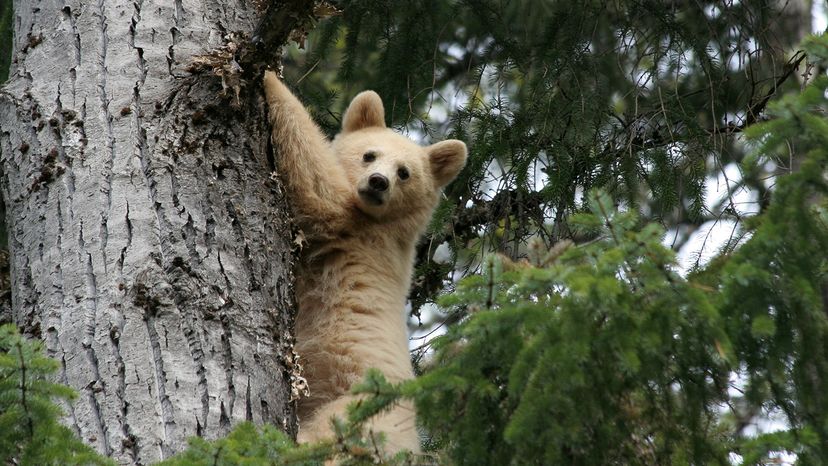
The elusive spirit bear looks like a light-hued teddy. Mike R Turner / Getty Images

A spirit bear looks almost mythical when it appears along a salmon river in the Great Bear Rainforest. The animal's creamy white coat stands out against the dark forest and fast rivers of coastal British Columbia.

Despite the name, the spirit bear is not a separate species. It is a rare white or cream-colored color phase of the Kermode bear (Ursus americanus kermodei), a subspecies of the American black bear. A unique genetic trait gives some individuals their famous pale fur.

Advertisement

These elusive animals live only in a remote stretch of rainforest on Canada's north and central coast, where dense forest, salmon-rich rivers, and coastal islands create the perfect habitat.
What Makes a Spirit Bear White

bear
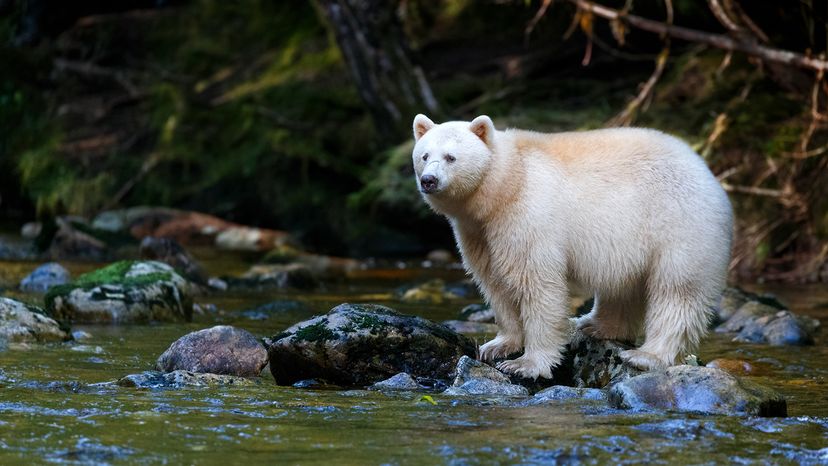
Seriously, this isn't a polar bear. Look at its environment. KenCanning / Getty Images

Spirit bears, also called Kermode bears, are black bears that carry a rare recessive gene affecting coat color. When a cub inherits the gene from both parents, its entire coat grows in white or creamy fur rather than the usual black.

This genetic variation occurs at the MC1R gene, which influences pigmentation. Unlike albino animals, spirit bears still have dark eyes and pigmented skin beneath their fur.

Advertisement

Some black bears in the region carry this gene. Only a small fraction are actually born white, which is why the white bear is so rare.

The subspecies is named after Francis Kermode, a British Columbia zoologist who studied these bears many years ago.

Advertisement

Where Spirit Bears Live

Spirit bears exist only in the Great Bear Rainforest, a vast coastal ecosystem covering about 6.4 million hectares (15.8 million acres) along the north and central coast of British Columbia.

Many of the white Kermode bears live on islands such as Princess Royal Island and the nearby Gribbell Island. These remote locations lie roughly 497 miles (800 km) north of Vancouver and are accessible mainly by air or sea.

Advertisement

The rainforest contains towering trees, rivers full of salmon and rich plant life. Marine nutrients carried inland by spawning fish feed other plants and animals throughout the forest.

Because the habitat is so isolated, spirit bears remain one of the most elusive bears in the world. Wildlife tours operated by Indigenous groups—including Spirit Bear Lodge—sometimes allow visitors to observe them during salmon season.

Advertisement

How Spirit Bears Find Food

bear
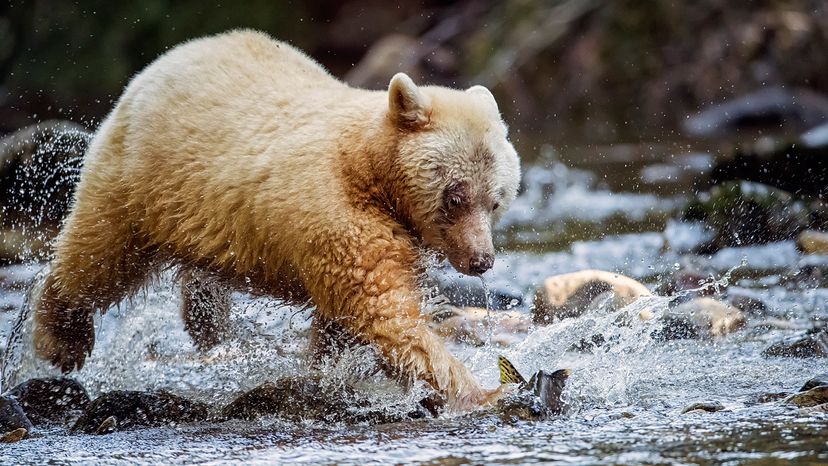
Like many North American bears, the spirit bear is a big fan of salmon. Robert Postma / Design Pics / Getty Images/Design Pics RF

Like other black bears, spirit bears are omnivores that eat a wide variety of foods. Their diet can include berries, roots, grasses, nuts, insects, and occasionally small animals or carrion.

However, Pacific salmon are the most important food source. During the fall spawning season, bears gather along rivers to catch salmon moving upstream.

Advertisement

Scientists believe the white coat may help spirit bears catch fish. Research suggests they can be about 35 percent more successful at catching salmon during the day because the lighter color is less visible to fish underwater.

These bears may spend long hours fishing in fast moving streams. In summer they also roam the forest feeding on berries and other plants to build fat reserves.

Advertisement

Life Cycle of a Spirit Bear

Spirit bears are solitary animals that wander large areas in search of food. They usually avoid other bears except during mating season or when mothers raise cubs.

Females typically reach sexual maturity between 2 and 9 years of age. Males usually mature between 3 and 4 years.

Advertisement

After mating, females give birth during winter hibernation. Cubs are born blind and remain in the den while the mother hibernates for roughly five to seven months.

Spirit bears may give birth every two years, though some females wait three or four years between litters. Adult bears can weigh anywhere from about 135 to 600 lb (61 to 272 kg), with males generally larger than females.

Advertisement

Cultural Importance of the Spirit Bear

For thousands of years, Indigenous peoples along the coast of British Columbia have lived alongside spirit bears. Communities such as the Kitasoo/Xai'xais and Tsimshian consider the animal sacred.

In many traditions, the spirit bear is known as moskgm'ol, meaning "white bear." Stories describe how the Creator Raven turned one in every ten black bears white to remind people of the last Ice Age when glaciers covered the land.

Advertisement

Because of this cultural importance, many Indigenous communities historically avoided speaking about the bears publicly to protect them from hunters. Seeing one is often believed to bring good fortune or spiritual insight.

The spirit bear has become a symbol of the Great Bear Rainforest and the balance between people and nature in the region.

Advertisement

Why Spirit Bears Need Protection

The spirit bear population is extremely small. Scientists estimate there are only about 100 to 400 individuals in the wild.

Their survival depends on protecting the old growth forests and salmon rivers of the Great Bear Rainforest. Logging, habitat destruction, and declining salmon runs can threaten their food supply and denning areas.

Advertisement

Another risk comes from hunting black bears in the region. Hunters might accidentally kill black bears that carry the gene responsible for white fur, reducing the chance of spirit bear cubs being born.

Conservation groups such as the Raincoast Conservation Foundation and Valhalla Wilderness Society advocate for habitat protection across the rainforest.

Preserving this remote ecosystem helps ensure that one of the world's rarest bears continues to exist in the wild.

We created this article in conjunction with AI technology, then made sure it was fact-checked and edited by a HowStuffWorks editor.

Advertisement

Advertisement

Loading...