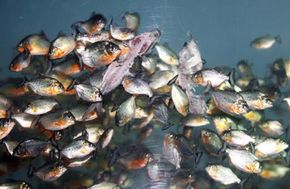
When Theodore Roosevelt went on a hunting expedition in Brazil in 1913, he got his money's worth. Standing on the bank of the Amazon River, he watched piranhas attack a cow with shocking ferocity. It was a classic scene: water boiling with frenzied piranhas and blood, and after about a minute or two, a skeleton floating to the suddenly calm surface.
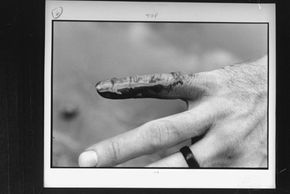
Roosevelt was horrified, and he wrote quite a bit about the vicious creatures in his 1914 book, "Through the Brazilian Wilderness." He recounted the stories of townspeople who had been eaten alive, and others who'd lost body parts to piranhas while bathing in the river. "They are the most ferocious fish in the world," Roosevelt announced to the world. "[T]hey will snap a finger off a hand incautiously trailed in the water; they mutilate swimmers -- in every river town in Paraguay there are who have been thus mutilated; they will rend and devour alive any wounded man or beast; for blood in the water excites them to madness" [source: ESPN]. The legend of the piranha had begun.
Advertisement
Hollywood picked it up from there with the 1978 horror flick "Piranha" ("When flesh-eating piranhas are accidentally released into a summer resort's rivers, the guests become their next meal"), 1981's "Piranha II: The Spawning," and a remake of the original B-movie that came out in 2010 [sources: IMDb, Movie Insider]. The killer piranha has made the gory jump into the 21st century.
But is the vicious reputation deserved? Roosevelt witnessed the now-famous cow stripping incident in Brazil, where piranhas live in especially high numbers. However, they're native to and pretty common all along South America's Amazon River -- from Argentina to Colombia. So are South American bovines a regular meal for these ferocious fish? And why are there cows hanging out in the Amazon River?
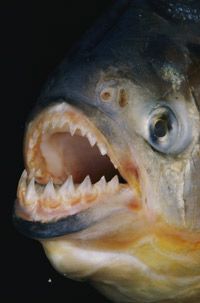
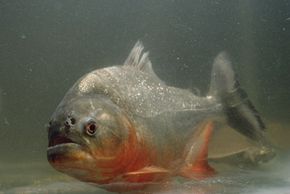
Setting aside the account of a former U.S. president, piranhas stripping a cow -- or a human -- to the bone in less than a minute is a tough sell. How would that even be possible for a bunch of 10-inch, 3-pound fish?
Let's find out.
Advertisement