Can piranhas really strip a cow to the bone in under a minute?

When Theodore Roosevelt went on a hunting expedition in Brazil in 1913, he got his money's worth. Standing on the bank of the Amazon River, he watched piranhas attack a cow with shocking ferocity. It was a classic scene: water boiling with frenzied piranhas and blood, and after about a minute or two, a skeleton floating to the suddenly calm surface.

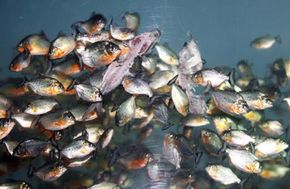
Piranhas kept at Sea World in Jakarta enjoy a feeding frenzy.
Adek Berry/AFP/Getty Images
Piranhas kept at Sea World in Jakarta enjoy a feeding frenzy.

Roosevelt was horrified, and he wrote quite a bit about the vicious creatures in his 1914 book, "Through the Brazilian Wilderness." He recounted the stories of townspeople who had been eaten alive, and others who'd lost body parts to piranhas while bathing in the river. "They are the most ferocious fish in the world," Roosevelt announced to the world. "[T]hey will snap a finger off a hand incautiously trailed in the water; they mutilate swimmers -- in every river town in Paraguay there are men who have been thus mutilated; they will rend and devour alive any wounded man or beast; for blood in the water excites th­em to madness" [source: ESPN]. The legend of the piranha had begun.

Animal Links

Hollywood picked it up from there with the 1978 horror flick "Piranha" ("When flesh-eating piranhas are accidentally released into a summer resort's rivers, the guests become their next meal"), 1981's "Piranha II: The Spawning," and a remake of the original B-movie due out sometime in 2008 [sources: IMDb, Movie Insider]. The killer piranha has transitioned to the 21st century with even more gore.

But is the vicious reputation deserved? Roosevelt witnessed the now-famous cow stripping incident in Brazil, where piranhas live in especially high numbers. Howev­er, they're native to and pretty common all along South America's Amazon River -- from Argentina to Colombia. So are South American bovines a regular meal for these ferocious fish? And why are there cows hanging out in the Amazon River?

Tooth Fish
The name “piranha” is derived from the Tupi Indian language, native to Brazil. It’s a combination of the Tupi word pira, or “fish,” and ranha, meaning “tooth."


Setting aside the account of a former U.S. president, piranhas stripping a cow -- or a human -- to the bone in less than a minute is a tough sell. How would that even be possible for a bunch of 10-inch, 3-pound fish?

Let's find out.

­

Piranha!

Roosevelt explored the exotic Brazilian Amazon as an avid hunter, but he wasn't exactly the common tourist. He was a former U.S. president, and his guides wanted him to be very pleased with his trip. But what he saw was real: piranhas stripping a cow to the bone in a shockingly short period of time. Whether it was really under a minute, we'll never know. But we do know that this type of attack is feasible for piranhas. What Roosevelt witnessed had some special circumstances, which we'll get to later. Nonetheless, it was a disturbing sight, considering the size of these fish.

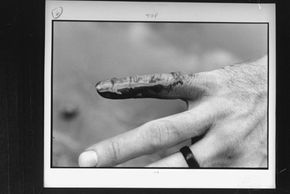
A finger bitten by a piranha.
H. John Maier Jr./Time Life Pictures/Getty Images
A man displays his bloodied finger after dipping his hand in the piranha-infested waters of the Parapeti River.

We're not talking monsters here. While piranhas top out at about 2 feet (60 cm), most are about 8 inches (20 cm) from head to tail and weigh just a few pounds. The most vicious of the roughly 20 species found in the Amazon River, the red-bellied piranha (Pigocentrus naterreri), is on the small end of the spectrum and usually weighs about 3 pounds (1.36 kg) [source: ESPN]. The next most aggressive species is the black piranha, (Serrasalmus rhombeus), which tends to be bigger than the red-bellies.

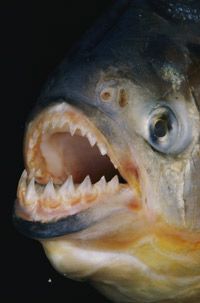
A piranha bears its fearsome teeth.
Paul A. Zahl/National Geographic/Getty Images
A piranha bears its fearsome teeth.

In the case of piranhas, it's not the size that counts. It's the teeth.

A piranha's teeth are only about a quarter-inch (4 mm) long, but they're like razors, and the whole jaw mechanism is designed for chomping efficiency. The teeth are spaced in an interlocking pattern, so when a piranha jaw snaps shut, the top teeth and the bottom teeth interlace like dozens of razor-sharp scissors. The jaws are incredible strong: Some people who have lost toes to piranhas have actually lost the entire toe, bone included.

The reason why piranhas can strip a large animal like a cow down to a skeleton so quickly is because of a few factors. First, piranhas don't chew. When they bite down, the big chunk of flesh they take out of the cow goes right into their bellies. They just keep snapping their jaws shut and filling themselves up. Next, that type of task is accomplished by hundreds of piranhas, not just the typical school size of 20, and piranhas are very efficient team eaters. In a feeding frenzy, they rotate continuously, so as each piranha takes a bite, it moves out of the way so the piranha behind it can get a bite, and so on. They take turns with incredible speed, which is where the boiling-water effect comes from. The piranhas are constantly changing position during a feeding frenzy.

Another important factor involved when piranhas eat a large animal in minutes has to do with the special circumstances surrounding what Roosevelt saw: Feeding frenzies happen when piranhas are starving. It's not an everyday occurrence. Roosevelt's guides in Brazil had set up the scene for their famous guest. They had set nets to close off a small part of the river and had tossed hundreds of piranhas into it, trapping them. By the time they threw that cow into the water, the piranhas had been starving for some time.

Full Circle
Even though piranhas are small, they’re seldom eaten alive by other fish. That razor sharp bite would really hurt going down. But piranhas are eaten regularly by herons and caimans (small gatorlike creatures) during the dry season, when water levels are low and piranhas end up trapped in small pools with no food. When they lay dying and unable to defend themselves, the herons and caimans -- who had watched the piranhas eat their defenseless young during the wet season -- come in and finish them off.


So if eating an entire cow in under a minute isn't the norm, how and what do piranhas usually eat?

­

Piranha Feeding: The Daily Grind

Attacking a live animal isn't out of the question for piranhas, but it's not likely they could take down a healthy, full-grown human. They have, however, been known to attack sickly, old animals that come to drink from the river. When a cow lowers its head, they'll clamp onto its face. If the cow is too weak to fight back, the piranhas will drag it into the water and eat it. But live prey isn't the mainstay of their diet. Mostly, they're scavengers. The skeletons of animals and people found in the Amazon, apparently eaten by piranhas, weren't attacked alive. They were already dead when the piranhas got to them.

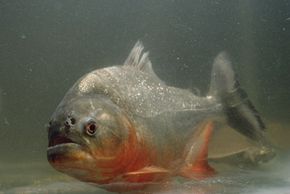
Most piranhas, like this red-bellied piranha, simply nip at other fish as the pass.
Claus Meyer/Minden Pictures/Getty Images
Most piranhas, like this red-bellied piranha, simply nip at other fish as the pass.


As with other fish, mammals are by no means a big part of the piranha's diet. They eat other fish, mostly, and sometimes other piranhas. An aquarium in Wales that had gone to considerable trouble to acquire a male and a female piranha (piranhas are illegal to import in most parts of the world, including Britain) in hopes the two would mate, were disappointed when the female ate her potential suitor [source: BBC News]. But piranhas aren't strict carnivores. They'll eat fruits and plants, too, especially when they're young.

Contrary to legend, most piranhas don't really attack anything. Twelve of the 20 species in the Amazon survive entirely on taking small bites out of the fins and scales of other fish as they pass by. The fish swim away only slightly disturbed, and their fins and scales grow back.

While piranhas aren't quite the vicious man-eaters of myth, attacks on humans have been increasing in frequency. In South America, people have been losing fingers and toes more often than they were just 10 years ago, and experts believe it might have something to do with an increase in the number of dams on the Amazon River. Dams slow the current, and piranhas like to breed in the slowest-moving waters. Creating more placid areas along the river is an invitation to piranhas to come set up camp in large numbers. Since placid areas also attract swimmers, humans and piranhas are coming into contact more and more.

No Piranhas Allowed
Piranhas are only native to South America. But in the last couple of decades, they’ve been showing up in rivers all over the world. The most likely explanation is that people who keep piranhas as pets are releasing them into the river. Piranhas aren’t the easiest fish to keep in home aquariums. When owners suddenly discover all of their other fish have been eaten, or decide it’s way too expensive to keep a piranha well-fed, some just drop them in the nearest body of water, causing serious threats to the ecological balance there. Many countries have outlawed piranhas entirely because of the threat.


For more information on piranhas and related topics, swim through the links on the next page.

­

Lots More Information

Related HowStuffWorks Articles

More Great Links

Sources

  • China orders piranhas destroyed. BBC News. December 24, 2002. http://news.bbc.co.uk/2/hi/asia-pacific/2603689.stm
  • Hungry piranha seeks good catch. BBC News. June 1, 2000. http://news.bbc.co.uk/2/hi/uk_news/wales/772802.stm
  • Piranha. Encyclopedia Britannica.
    http://search.eb.com/eb/article-9060157
  • Piranha. Extreme Science.
    http://www.extremescience.com/Piranha.htm
  • Piranha. HowStuffWorks. http://animals.howstuffworks.com/fish/piranha-info.htm
  • Piranha increase "due to dams". BBC News. December 28, 2003. http://news.bbc.co.uk/1/hi/sci/tech/3346301.stm
  • Piranhas. London Aquarium.
    http://www.londonaquarium.co.uk/files/factsheets/Piranhas.pdf
  • Rumble in the jungle with Amazon's killer piranha. LA Times. November 22, 2005. http://travel.latimes.com/articles/la-os-piranha22nov22
  • Sutton, Keith "Catfish." Out there: Piranha! ESPN.com. http://sports.espn.go.com/outdoors/tv/columns/story?columnist=
    sutton_keith&page=g_col_sutton_piranha

  • The Truth About Piranha Attacks. Practical Fishkeeping. http://www.practicalfishkeeping.co.uk/pfk/pages/item.php?news=1180