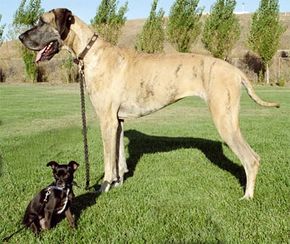
Bonnie, a Brindle Great Dane, with Sparkle, a Chihuahua mix.
Photo courtesy Ellen
The relationship between people and dogs goes back at least 15,000 years, making dogs potentially the first animal to be domesticated. In that time, dogs have played many roles and performed many jobs for their human companions. Dogs come in a startling variety of shapes and sizes, but from the giant and noble Great Dane to the tiny and tenacious Chihuahua, they are all one species with one basic history.
In this article, we'll explore where dogs came from and why they look and act the way they do. We'll also learn what recent genetic work has to tell us about our dogs and talk about how to find the right dog for you.
Advertisement
The Dawn of the Dog
Dogs are members of the family Canidae. Canids are part of a larger group called Carnivora, which also includes bears, cats and seals. Fossils show us that Canidae split off from the common ancestors of Carnivora about 40 million years ago. From about 15 million years ago, we can subdivide Canidae into three subgroups: fox-like animals, wolf-like animals and South American canids, such as the maned wolf and crab-eating fox. Members of the wolf-like group include wolves, coyotes and jackals, which are all closely related.
Observing the diversity of dogs and wild canids, scientists like Charles Darwin reasoned that different types of dogs might be descended from different types of wild canids. However, modern DNA analysis shows us that dogs are descended only from wolves.
In the next section, we'll look at how this evolution might have happened.
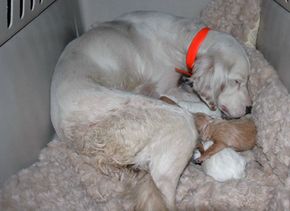
Like wolf puppies, newborn dogs are blind, deaf, and completely dependent on their mother.
Photo courtesy Hannah Harris
Even if it's clear that dogs are descended from wolves, it is less obvious how this came about. The conventional view, and one widely represented in both fiction and nonfiction, is that prehistoric people took wolf pups from their dens and reared them to think of people as their "pack." These tamed wolves lived with people and reproduced. The people that cared for them treasured individuals with odd coats or heavier bone structure, which might have meant death in the wild. Over time people began to breed these wolf-dogs selectively until they eventually created the diversity of dogs we see today.
The problem with this theory is that the initial shift from wolf-like to dog-like traits could only have happened very slowly. Wolves are relatively uniform in appearance, so the odds of a mutation appearing randomly in a captive population are small. It would have taken many thousands or even millions of years to get much diversity. Yet fossil evidence shows that dogs appeared not all that long ago. If it's true that dogs have existed for only about 15,000 years, this is a blink of the eye in evolutionary terms. DNA evidence indicates that dogs may have begun to split with wolves as many as 100,000 years ago, but this is still relatively recent. Yet in dogs we see some of the most extreme physical diversity of any mammalian species. There is more variation in size, color, coat texture and other aspects of appearance within dogs than there is among all other members of the canid family.
Advertisement
So, how did it happen?
Recent publications, such as the controversial book "Dogs: A Startling New Understanding of Canine Origin, Behavior, & Evolution," by Raymond and Lorna Coppinger, present an alternative theory for the way that dogs evolved from wolves. The Coppingers suggest that some wolves "domesticated themselves." When humans went from mobile hunter/gatherer societies to sedentary villagers, they created a new ecological niche for neighboring wolves. The traditional niche for wolves is a forest predator of herbivores (plant-eaters) such as deer and elk. This niche requires wolves to be large, strong, innovative and able to learn by example.
Humans living together in a group produce food scraps and other waste, which represents a valuable food source for animals. Wolves living near people began taking advantage of these resources, and the boldest wolves got the most and survived the best.
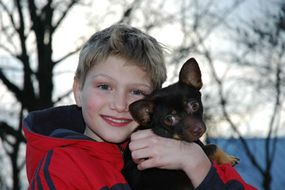
By the time wolf pups are 19 days old, they are becoming suspicious of strangers. In contrast, dogs (like this Chihuahua mix) are willing to make connections with people up until 4 months of age.
Photo courtesy Hannah Harris
Studies with captive wolves demonstrate that while you can raise wolves to be somewhat tolerant of people, they retain a suspicious nature and are extremely difficult to train. Even wolves that have been captive bred for generations don't act like dogs.
Historically, being timid and avoiding humans was a good strategy for wild wolves, but in this case the timid wolves spent too much energy running away and weren't able to scavenge as effectively as the bolder ones. The bolder wolves survived better, reproduced with each other and had more offspring who were even bolder. One group of wolves split from the forest hunters and went down a different evolutionary path. This new group of wolves didn't need to be as fast or as creative as their ancestors. In fact, being small was now better because smaller animals require less food. The main quality that the individuals in this new group needed to succeed was to be tolerant of humans. This process was driven by natural selection.
In the next section, we'll learn how both natural and artificial selection led to the evolution of the modern dog.
Advertisement
The Evolution of Dogs
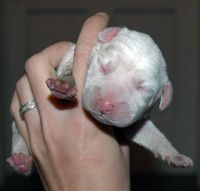
A newbornEnglish Setter puppy
Photo courtesy Hannah Harris
Natural selection is the process that Darwin proposed as the mechanism behind evolution. Essentially, it works like this: There is genetic diversity within any population. In animals, this genetic diversity manifests itself in physical and behavioral variations. Animals may be slightly bigger or smaller, differently colored, faster or slower, or more or less aggressive. Some of these characteristics are neutral -- they neither benefit nor harm the individual that has them. However, some of these qualities affect the ability of the individual to survive and reproduce. Animals that need to hide but are oddly colored and more visible than the rest of their species will probably die young without offspring. When that happens, the genetic variations that cause that odd coloration will be lost. This trait is selected against. Conversely, animals that have a beneficial quality will survive better and reproduce more, increasing the proportion of those traits in the population. As those traits become more common, the population overall changes as it becomes better suited to its environment. This is evolution.
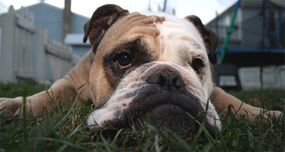
Artificial selection is a similar process, but people select the traits that continue instead of "survival of the fittest." Traits favored by people may or may not be directly beneficial to the animal, but it doesn't matter as much because these are the animals that people choose to breed. For example, artificial selection for increasingly large heads in bulldogs means that many bulldog puppies must now be born by Caesarean section. This is not a trait favored in nature, but with the aid of veterinary medicine, it's possible to select for an animal with these qualities.
Advertisement
Napoleon, an English Bulldog
Photo courtesy MorgueFile
Where did all the diversity come from? Studies conducted on Russian fox farms may reveal the answer. In the 1950s, Russian scientist Dmitri Belyaev began selectively breeding captive silver foxes on a fur farm with the idea of making them tamer and easier to handle. He carefully chose foxes that were more tolerant of humans than the rest. Over a few generations of breeding, the foxes became tamer. However, they also developed strange coat colors and other odd characteristics, such as floppy ears and curly tails. Belyaev's new foxes barked more, and the females came into heat more often and younger than their ancestors. In fact, Belyaev's foxes had exactly the same kinds of qualities we see in dogs, but never in wolves. Why should selecting for tamer animals also create individuals with all these unusual physical qualities?
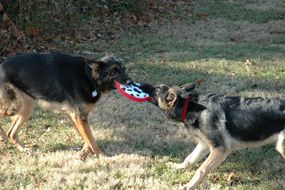
These German Shepherds exhibit playful, puppy-like behavior in a game of tug o' war.
Photo courtesy Hannah Harris
The theory is that by selecting for individuals that are friendlier and less suspicious of humans, you also affect some aspects of the developmental process. You're breeding animals that are more puppy-like in their behavior. Linked to the genes that control this extended puppyhood are other genes that affect coat color. In addition, when you lengthen the amount of time behavioral development takes, you disrupt some other types of development.
Based on the research on foxes, the natural selective pressure on village wolves to be tamer might have simultaneously created a population of wolves with all kinds of odd characteristics. Now you have a group of animals that are smaller and friendlier than wolves and that come in lots of colors. This is the point at which researchers like the Coppingers say that humans began adopting puppies and favoring some attributes over others, using artificial selection to create different types of dogs.
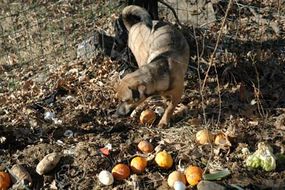
Milo, an example of a proto-dog, checks out a compost pile
Photo courtesy Hannah Harris
You can still see artificial selection in action in many parts of the world, where dogs exist on the margins of society and feed on scraps. These "pariah" dogs are of relatively uniform size, but vary in color. They are probably not descended from purebred dogs, as there is no local history of purebred dogs kept as pets. Instead, they represent what could be the original dog type, or proto-dog, evolved from wolves to take advantage of the niche that humans provide. People sometimes take unusual individuals as pets, and in some cases, these animals are bred and pass on these special qualities. If certain qualities are consistently favored over time, we begin to see the creation of a breed via artificial selection.
If the final process of artificial selection is the same, distinguishing between these two theories of the evolution of dogs may seem like splitting hairs. In either case, some wolves became dogs because of their association with people. However, the new (and even heretical) idea that groups of wolves evolved into dogs via natural selection means dogs are not simply domesticated wolves. They are truly their own species, shaped by the same process that created coyotes and other canids that have split from each other on the family tree. Perhaps by viewing dogs as deformed or substandard wolves created by people, we fundamentally misunderstand and underestimate them as the unique species that they are.
At some point, people living in proximity to dogs got the idea that dogs might be useful for more than just eating trash. Dogs bark to warn each other when there's an intruder. Their superior senses of smell and hearing make them better at spotting prey than human hunters, and their size and agility make them better at flushing and catching it.
According to the Coppingers, wild wolves are predators and their behavior follows a seven-step sequence:
Advertisement
Orient
Eye
Stalk
Chase
Grab
Bite-Kill
Bite-Dissect
First, the wolf notices its prey. Then it focuses intently on the prey (sometimes called giving "the eye") and stalks in a slinking motion to prepare for the chase. The chase can culminate in either a grab/bite or kill/bite, and this sequence can break down before the kill or dissect stage.
Wolves must use all of these behaviors to survive. In dogs, this pattern breaks down. The pariah dogs don't need all these behaviors if they're primarily scavengers. As people have bred dogs, they have pulled the pattern apart, emphasizing certain aspects and downplaying or eliminating others, depending on their purpose.
People can promote certain characteristics by either breeding pairs of dogs that share the desired qualities or by allowing dogs to breed randomly but culling puppies from the litter that do not possess those characteristics. In either case, the genetic frequency for the desired quality goes up in each generation.
Herding dogs must eye and stalk, but never bite or kill. Hounds chase. Retrievers must grab the prey but should not dissect. Dogs that did their job well were allowed to reproduce, those that didn't were not. With intense selection, traits can be fixed in just a few generations. At some point, the new dog type may be called a "breed."
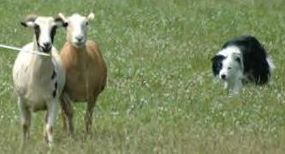
A Border Collie herding goats
Public domain image
A Border Collie herding goats closely resembles a wolf stalking its prey. The head is down, the body low to the ground, eyes riveted on the prey. However, the Border collie uses this behavior to move the goats, not hunt them. The amazing thing is that dogs are actually better at their section of the pattern than the wolves they descended from, they just don't have the whole set.
For a type of dog to be recognized as a breed, there must be a record of breeding going back generations. These animals must be "true breeding" -- that is, they must produce relatively homogenous offspring. For each breed recognized by groups such as the American Kennel Club, there exists some type of breed standard. This standard is a full description of what the ideal specimen of this breed should look like and how it should act. The standard can cover everything from coat color, length and texture to stance, attitude and eye shape. Not every purebred dog of this breed will look or act in accordance with the standard, but reputable breeders work towards this goal.
We'll take a look at purebred dogs and "designer mixes" next.
Bottlenecks and Founder Effects
Often just a few original individuals can generate a new breed of dogs. This creates a founder effect. This means that while there may be lots of genetic diversity among all dogs, only the specific versions of those genes possessed by the small number of founders will be part of the new line. For example, if a white coat is a desired quality, the breeder might select only white dogs as a foundation. Although many other colors of dogs exist, their versions of genes that code for those colors are not going into this new breed. This reduces the genetic diversity of the breed.
Bottlenecks can also reduce genetic diversity. Sometimes large numbers of animals are lost to the breeding population; perhaps the breed becomes unpopular or a disease wipes out many dogs in an area. In this case, much of the genetic diversity is lost as the breeding population is reduced to a small number of individuals. Even if the breed becomes popular again and the population increases, the genetic diversity of the original population is no longer available.
Advertisement
Purebred Dogs and Designer Mixes
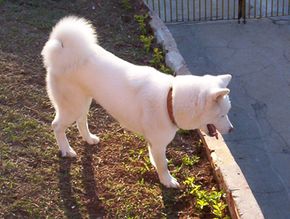
A white Akita Inu, or Japanese Akita
Photo courtesy Rodrigo Ambrozini/ SXC
Purebred dogs represent genetically closed populations. Most dogs of a single breed are genetically similar and closely related to each other. The rarer the breed, the more true this is. A genetic analysis of five dog breeds showed a fair amount of genetic diversity present in the relatively common Golden Retriever, but very little diversity in the more unusual Akita. There aren't as many Akitas to choose from, so all of them are closely related. Close breeding means that purebred dogs are uniform in appearance. It is also difficult to escape genetic problems, because so many of the dogs in that closed population share the same ancestry.
A "purebred" dog isn't necessarily high quality, healthy, or a good representative of the breed. Some puppies from top-quality adults may be closer to the standard than other puppies. Unscrupulous dog sellers may capitalize on the cachet of breeding and registration to command top prices, but many purebred dogs have serious health problems.
Advertisement
With the advent of cloning, the future of dog breeding could go in a different direction. Last year, South Korean researchers reported that they had successfully cloned a male Afghan hound to create a genetically identical dog named Snuppy (which stands for Seoul National University puppy). To learn more about cloning, see How Cloning Works.
The latest fad in dog breeding is the creation of so-called designer mixes. People breed one purebred animal to a purebred animal of a different breed in the hopes of capturing the best qualities of each and perhaps even eliminating the negatives. Some of the most common mixes are between Retrievers, such as Labradors, and standard Poodles. These "Labradoodles" are supposed to have the friendly, gentle natures of the Retriever and the low-shedding attributes of the Poodle.
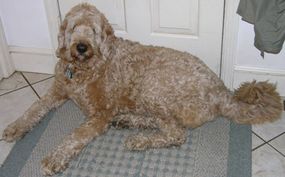
An F1 (first generation) Labradoodle
Photo courtesy Derek Ramsey
Gregor Mendel (1822-1884) developed basic laws of genetics using crosses between pea plants with different qualities - green or yellow peas, tall or short plants, etc. The same principles, now called Mendelian genetics, also apply to dogs. The most basic genetic scenario is where a gene on a specific locus determines each trait. (The location of a particular gene is called the locus of the gene.)
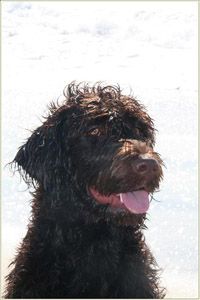
Another variation of an F1 Labradoodle
For example, a straight or curly coat might be determined by two different versions of the same gene. These alternative versions, which differ slightly in their DNA sequence, are called alleles. An individual dog inherits one allele at this coat-type locus from each parent. The alleles may be the same or they may be different. If they are the same, the individual is homozygous at that locus. If they are different, the individual is heterozygous. (Check out the "Understanding the Gene Pool" section of How Gene Pools Work for a more detailed explanation.)
Closely bred dogs tend to be homozygous at the loci that determine coat type. When you breed a dog that is homozygous for one coat type to a dog that is homozygous for a different coat type, then you get a litter of puppies that are all heterozygous at that locus. In reality, inheritance of coat type can be more complicated than that represented by simple Mendelian inheritance, but the basic principle is the same. All the Labradoodles in the litter will have similar coat types (in this case, wavy and low shedding), the result of the combination of the different alleles of their two parents.
However, you can't breed one Labradoodle to another Labradoodle and get Labradoodle offspring, because they aren't a pure breed. You are instead breeding a heterozygote to another heterozgote. In this case, you will have some puppies that are more like Labs, some that are more like Poodles, and potentially everything in between. This is because these are mixes bred to mixes and not true-breeding individuals. The other thing to remember is that hereditary problems like hip dysplasia are present in both breeds and are not eliminated by cross-breeding.
Advertisement
Dog Types
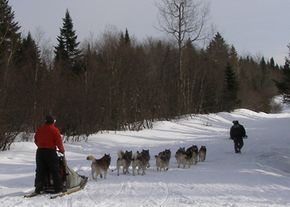
Dogs pulling a sled in New Hampshire
Photo courtesy Roy White/ SXC
As we've discussed, dogs have been bred for very different purposes. People bred some dogs as companions. For example, "lap dogs" were bred to sit in people's laps. In contrast, other dogs were selectively bred to be active -- good at herding sheep, pursuing game, or pulling sleds. As people bred good sled-pullers to other good sled-pullers, they created line of dogs genetically programmed to pull. These dogs don't just pull for a reward -- for them, pulling is the reward. They love to do their job. This works well when what you want is to get across the icy tundra, but it doesn't work at all when what you want is a dog to heel nicely at your side. This is not to say that a sled dog can't be taught to heel, but it's uphill work because you're fighting generations of careful breeding to do the opposite.
Advertisement
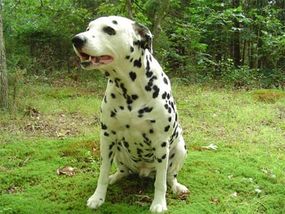
Each year, thousands of dogs end up in animal shelters and rescue groups for doing what people have bred them to do. An Australian shepherd that doesn't have sheep may still have the drive to herd. In the absence of sheep, he may try to herd children, cats or even pinecones. But children and cats don't especially like to be herded (though pinecones don't seem to mind). Dalmatians were bred to have incredible stamina so they could run all day alongside their coaches. But this also means that they aren't satisfied with a quick walk around the block. Rottweilers were bred to drive cattle, using their powerful frames to muscle the cows along the road to market. The cows are gone, but Rottweilers are just as strong.
Dalmatians are very active dogs and need lots of exercise.
Photo courtesy Emily Roesly/MorgueFile
Breeding is more than skin deep, and it's important to research the background of any dog you're considering adding to your household. In the next section, we'll discuss the importance of finding the right dog for you.
Within popular breeds, there sometimes exist multiple lines of animals, bred with different goals in mind. A dog show is like a beauty contest. Judges are looking to see how closely the dogs resemble their breed's standards, but while the dogs are required to be well behaved, they aren't judged on the job they were designed to perform. Sometimes a good show dog isn't a good working dog. For example, a Cocker Spaniel with a long, lush coat may do very well in the show ring, but get tangled in briers.
Many dog breed enthusiasts try hard to marry both form and function in their dogs, not only showing them but also competing in field or herding trials. However, dog breeds often diverge into "show" lines or "working" lines. Sometimes the subtypes within the breed diverge so far that the people involved decide it is no longer one breed but two. There are now two kinds of Cocker Spaniel: the American Cocker, known as a family dog with a luxurious coat, and the English Cocker, a hunting dog with a shorter coat. For more, check out the article How Work.
Advertisement
Choosing a Dog
Figuring out how the new addition will fit into the rest of the family is also an important factor when choosing a dog.
Photo courtesy Hannah Harris
Depending on your hopes for your new dog, you should learn about what your dog's ancestors were bred to do. A German Shepherd whose parents and grandparents excelled at Schutzhund will have a very different temperament and energy level than one whose family were mostly pets.
Within any breed there are individuals that represent more or less of the qualities the breed emphasizes. Consider a breed rescue where purebred dogs are carefully evaluated for their drive and energy level. On the other hand, a mixed breed dog may suit you best.
Advertisement
Responsible breeders and rescuers work hard to help match people with the right dog for their personality and lifestyle. They know that a dog whose energy and intellectual needs are met is a happy, well-behaved dog.
The best dog in the world for one person could be a nightmare for someone else. When searching for a new dog, it is important to avoid breeders that are more interested in making money than producing quality dogs for appropriate homes. Breeding dogs for profit is controversial, because there are already many more dogs than available homes. In addition, breeding responsibly involves so much expense that making a profit may indicate corner cutting somewhere along the line. For more information on how to select a responsible breeder, see the links in the next section.
The relationship of humans with dogs is both long and involved. Dogs are an integral part of more aspects of human society and culture than any other species. Today there are more than 350 recognized breeds, an infinite number of mixes and dogs that are no breed at all. There are dogs that find lost people, detect bombs and drugs, guide the blind, herd and guard livestock, and comfort the sick; there even dogs that can detect certain types of cancer. Most of all, there are dogs that simply share and enrich our lives. Knowing more about dogs allows us to find the right dog or to understand and appreciate the dog we already have.
For more information about what dogs do or how to choose the right dog for your lifestyle, check out the links in the next section.
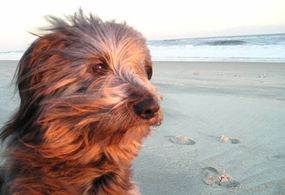
Jenkins contemplates life as a dog.
Photo courtesy Harris
The Shelter Situation
According to the Humane Society of the United States, an estimated 3 to 4 million cats and dogs die in shelters every year because there are simply not enough homes.
Please spay or neuter your pet (if cost is a factor, check out the HSUS site for assistance) and if you're thinking of adding a new dog to your family, consider a shelter or rescue group.
Beck, Alan M. "The Ecology of Stray Dogs: A Study of Free-Ranging Urban Animals." Baltimore: York Press, 1973.
Belyaev, D.K. "Destabilizing Selection as a Factor in Domestication." Journal of Heredity, vol. 70, pp. 301-308, 1979.
Clutton-Brock, J. "Origins of the dog: Domestication and early history." From "The Domestic Dog: Its Evolution, Behavior, and Interactions with People." edited by J. Serpell. Cambridge, UK: Cambridge University Press, 1995.
Coppinger, R. & Coppinger, L. " Dogs: A Startling New Understanding of Canine Origin, Behavior & Evolution." New York: University of Chicago Press, 2001.
Ellegren, H. "The dog has its day." Nature, vol. 438 pp. 745-746, 2005.
Fox, M. "Behavior of Wolves, Dogs and Related Canids." New York: Harper-Row, 1971.
Trut, L.N. "Early Canid Domestication: Farm Fox Experiment." American Scientist, vol. 87 pp. 160-169, 1999.
Trut, L.N. "An Experiment on Fox Domestication and Debatable Issues of Evolution of the Dog." Russian Journal of Genetics, vol. 40 pp. 644-655, 2003.
Vila, C. et al. "Multiple and Ancient Origins of the Domestic Dog." Science, vol. 276 pp. 1687-1689, 1997.
Cite This!
Please copy/paste the following text to properly cite this HowStuffWorks.com article: