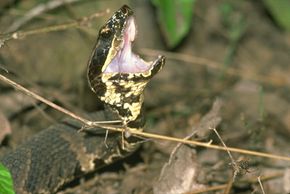
The Cottonmouth snake is also called the Water Moccasin.See more pictures of reptiles.
From a lead role as Eve's tempter in the Bible to regular appearances in the Harry Potter books and movies, snakes have slithered their way into world mythology and popular culture with tales born of fear as well as respect.
In the more than 130 million years since they appeared, snakes have evolved into a highly versatile vertebrate, boasting the ability to climb straight up, dart through water and, in some species, even fly -- all without limbs. Combine this mobility with a worldwide presence and a sometimes-deadly bite, and snakes can quickly become the stuff of myths.
Advertisement
In this article, we'll shed some of their mystique. You'll learn how snakes get around, how they kill and eat their prey, and how they court and reproduce, making note of some fascinating species along the way.
There are 2,700 known snake species, and the reptiles all share the following characteristics:
They have thin, linear and limbless bodies.
They are meat-eaters (carnivores).
They are cold-blooded (ectothermic), meaning their inner temperature varies with the temperature in the environment.
Snakes look like legless lizards for a reason -- the two reptiles make up the order Squamata, which is divided into the suborders Sauria for lizards and Serpentes (or Ophidia) for snakes. Because of their long shape, snakes' organs are arranged linearly, but they are otherwise similar to those of other vertebrates, including people. The bone-encased brain and sensory organs are contained in the head, and snakes have almost all the senses people do -- with a few interesting modifications:
Advertisement
Hearing - Although snakes are not equipped with outer ears like people, sound waves from the air hit their skin and are transferred from muscle to bone. When the sound reaches the ear bone beneath the skull, it sends vibrations to the inner ear, and the sound is processed by the brain.
Sight - Snakes do not see colors, but their eyes are equipped with a combination of light receptors: rods that provide low-light but fuzzy vision, and cones that produce clear images. The complexity of the eyes varies among species because of their different lifestyles. For instance, snakes that live primarily underground have smaller eyes that only process light and dark, but snakes that live above ground and hunt by sight have crystal-clear vision and good depth perception. Some species, specifically boas and pythons, have a second visual tool: Pit organs on their heads see heat sources in their surroundings like infrared goggles -- an effective ability for nocturnal hunters of warm-blooded animals.
Smell - Like humans, snakes breathe airborne smells into nasal openings that lead to an olfactory chamber for processing; but snakes have a secondary system, as well. When a snake flicks its tongue, it is gathering odor particles for transfer to two fluid-filled sacs at the roof of the mouth -- Jacobson's organs -- that lead to a second, smaller olfactory chamber. The tongue is used only to assist in this process; snakes do not have a sense of taste.
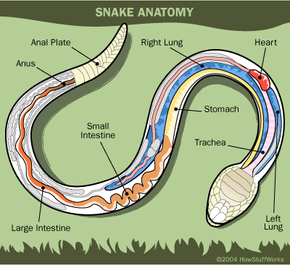
The digestive tract runs nearly the entire length of the body and includes the mouth, esophagus, stomach, small intestine, large intestine and anus -- all stretchable to digest prey larger than a snake's diameter (See Feeding section). When the snake's mouth is full, it has to extend its trachea (breathing tube) below the food and out in order to keep breathing. Snakes do not have a diaphragm like people do, so they circulate air in and out of the lungs by narrowing the rib cage to push air out and then widening it again to create a vacuum to suck air in. After each breathing cycle, snakes experience apnea -- a stop in breathing -- that lasts from a few seconds to as long as a few minutes. To process the oxygen, all snakes have an elongated right lung; many also have a smaller left lung, and a few even have a third lung along the trachea.
Two-headed Snakes
Two-headed snakes are less like the terrifying multi-headed monsters of myth and more like conjoined twins. Within the mother snake, an embryo begins to split to create identical twins, but the process does not finish, leaving part of the snake split and the other parts conjoined.
Unlike the mythical creatures, whose multiple heads make them significantly more dangerous, two-headed snakes rarely survive in the wild. With two heads, the senses are duplicated: When they sense prey, the heads will fight over which one gets to eat it. To make matters worse, if one head catches the scent of food on the other, it will try to eat its other head.
Advertisement
Snake Structure & Growth
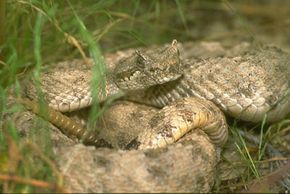
Sidewinder snake (a.k.a. "horned rattlesnake")
Snakes range from 4 inches (10 cm) to more than 30 feet (9 meters) in length. Hundreds of tiny vertebrae and ribs span this distance and connect to each other through an intricate system of muscles, creating unrivaled flexibility (See Getting Around section). An extremely elastic skin attaches to the muscles and is covered with scales made of keratin -- the same substance as human fingernails. The scales are produced by the epidermis, the outer layer of skin. As the snake grows, the number and the pattern of its scales stay the same, although a snake's scales are shed many times over the course of its life.
Unlike people, who shed worn-out skin constantly in tiny pieces, snakes shed all of their scales and outer skin in one piece during a process called molting. When the skin and scales start to wear down from time or injury, the epidermis begins to create new cells to separate the old skin from the developing inner layer. The new cells liquefy, making the outer layer soften. When the outer layer is ready to shed, the snake scrapes the edges of its mouth against a hard surface, such as a rock, until the outer layer begins to fold back around its head. It continues scraping and crawling until it is completely free of the dead skin. The molting process, which takes about 14 days, is repeated after anywhere from a few days to a few months.
Advertisement
Like people, snakes grow quickly until they reach maturity, which can take one to nine years; however, their growth, though much slowed after maturity, never stops. It's a phenomenon known as indeterminate growth. Depending on the species, snakes can live from four to more than 25 years.
Snake Movement
The key to snakes' agility -- hundreds of vertebrae and ribs -- is closely related to the key to their locomotion: ventral scales. These specialized rectangular scales line the underside of a snake, corresponding directly with the number of ribs. The bottom edges of the ventral scales function like the tread on a tire, gripping the surface and propelling the snake forward.
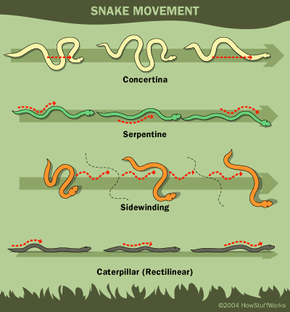
Snakes have four basic methods of movement:
Advertisement
Serpentine - This S-shape movement, also known as undulatory locomotion, is used by most snakes on land and in water. Starting at the neck, a snake contracts its muscles, thrusting its body from side to side, creating a series of curves. In water, this motion easily propels a snake forward because each contraction pushes against the water. On land, a snake usually finds resistance points in the surface -- such as rocks, branches or dents -- and uses its scales to push on the points all at once, thrusting the snake forward. Speckled rattlesnake using rocks as resistance points
Sidewinding - In environments with few resistance points, snakes may use a variation of serpentine motion to get around. Contracting their muscles and flinging their bodies, sidewinders create an S-shape that only has two points of contact with the ground; when they push off, they move laterally. Much of a sidewinding snake's body is off the ground while it moves.
Caterpillar - A much slower method of movement is caterpillar or rectilinear locomotion. This technique also contracts the body into curves, but these waves are much smaller and curve up and down rather than side to side. When a snake uses caterpillar movement, the tops of each curve are lifted above the ground as the ventral scales on the bottoms push against the ground, creating a rippling effect similar to how a caterpillar looks when it walks.
Concertina - The previous methods work well for horizontal surfaces, but snakes climb using the concertina technique. The snake extends its head and the front of its body along the vertical surface and then finds a place to grip with its ventral scales. To get a good hold, it bunches up the middle of its body into tight curves that grip the surface while it pulls its back end up; it then springs forward again to find a new place to grip with its scales.
Can Snakes Fly? & Anaconda: King of the Jungle
There are five different species of "flying" snakes. These venomous, tree-dwelling snakes are found in Sri Lanka and Southeast Asia.
They hang from a high branch and swing themselves into the air. They then flatten their bodies by widening their many ribs and use side-to-side, S-shaped motions to keep themselves in the air. These snakes cannot fly upward but can glide for a good distance.
The heaviest snake in existence is also one of the most prolific swimmers. The anaconda, which can weigh as much as 550 pounds (250 kg) and measure more than 12 inches (30 cm) in diameter, usually lives near slow-moving rivers and swamps in the jungles of South America. It spends most of its time in the water, where it can move much faster than on land, using its powerful muscles to propel itself through the water using serpentine locomotion.
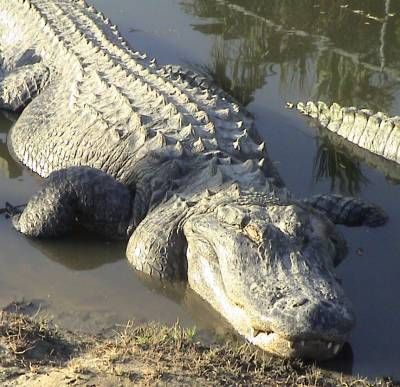
Like an alligator, the Anaconda's eyes and nostrils are located on the top of its head so it can see prey and breathe while keeping the rest of its body hidden beneath the surface. When it does go completely underwater, the anaconda can hold its breath for up to 10 minutes. These snakes copulate and give birth in the water, as well (See Snake Sex section). To feed, the non-venomous anaconda uses constriction to suffocate and often drown its prey (See Feeding section).
Snake Digestion: What a Snake Eats
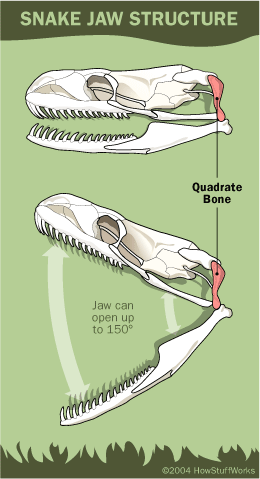
Although snake species have different methods of finding and catching prey, all snakes eat in basically the same way. Their amazingly expandable jaws enable them to prey on animals of much larger size -- and swallow them whole. Whereas the upper jaw of a human is fused to the skull and therefore unable to move, a snake's upper jaw is attached to its braincase by muscles, ligaments and tendons, allowing it some front-to-back and side-to-side mobility. The upper jaw connects to the lower jaw by the quadrate bone, which works like a double-jointed hinge so the lower jaw can dislocate, allowing the mouth to open as wide as 150 degrees. Also, the bones that make up the sides of the jaws are not fused together at the front like the human chin, but instead are connected by muscle tissue, allowing the sides to separate and move independently of one another. All of this flexibility comes in handy when a snake encounters prey bigger than its head -- its head can stretch to accommodate it.
Once a snake is ready to eat, it opens its mouth wide and begins to "walk" its lower jaw over the prey as its backward-curving teeth grip the animal -- one side of the jaw pulls in while the other side moves forward for the next bite. The snake drenches the prey with saliva and eventually pulls it into the esophagus. From there, it uses its muscles to simultaneously crush the food and push it deeper into the digestive tract, where it is broken down for nutrients.
Advertisement
Even with all of these advantages, eating a live animal can be a challenge. Because of this, some snakes have developed the ability to inject venom into prey to kill or subdue the animal prior to eating it. Some venom even gives the digestion process a kick-start. Snakes with this effective tool must have an equally effect way of getting the poison into an animal's system: fangs.
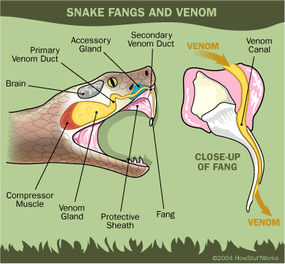
At the front or back of their upper jaw, venomous snakes have two sharp teeth that are hollowed out to allow the poison to pass through. Once a snake strikes, inserting these teeth into its prey, venom is squeezed from a gland under each eye into the venom duct -- where it passes more glands that release compounds thought to make the venom more effective -- and out through the venom canal in the fangs.
In non-venomous, constrictor snakes, the teeth are stationary; in snakes with long (grooved) fangs, the teeth fold backward into the mouth when not in use -- otherwise, the snake would puncture the bottom of its own mouth.
Although the venomous snake species -- which make up only one fifth of all snakes -- each have their own special brew, the following are the three most important types of toxins found in snake venom:
Neurotoxins - Affect the nervous system by seizing up the nerve centers, often causing breathing to cease
Cardiotoxins - Deteriorate the muscles of the heart, causing it to stop beating
Hemotoxins - Cause the blood vessels to rupture, resulting in widespread internal bleeding
Some venom may also include agglutinins, which make the blood clot, or anticoagulants, which make the blood thin. Most snake venom makes use of several of these compounds for a deadly combined effect. A few snakes squeeze the life out their prey in another way -- constriction. Once a snake has the animal firmly in the grip of its jaws, it loops its body in coils around the prey. When the animal exhales, letting the air out of its body cavity, the snake contracts its powerful system of muscles to tighten the coils, squeezing the body so that the animal cannot breathe in again. According to a Carnegie Mellon University study in 2002, depending on its size, a constrictor can apply 6 to 12 pounds of pressure per square inch. Although this pressure suffocates the prey by compressing the lungs, it can also have the same effect on the heart, speeding up death significantly.
Boa Constrictor: The Main Squeeze
The boa constrictor is related to the anaconda, but the boa stays out the water as much as the anaconda stays in it.
This non-venomous South and Central American snake, which can weigh more than 60 pounds (27 kg) and grow to nearly 10 feet (3 meters), uses the process of constriction to suffocate and kill its prey before eating it whole. It has been known to constrict and eat monkeys, rodents and other reptiles, often using its prehensile tail to hang from trees and drop down on prey.
One might think having no limbs would put a damper on the love life, but not for snakes. When a female snake is ready to mate, she begins to release a special scent (pheromones) from skin glands on her back. As she goes about her daily routine, she leaves an odor trail as she pushes off resistance points on the ground (See Getting Around). If a sexually mature male catches her scent, he will follow her trail until he finds her. The male snake begins to court the female by bumping his chin on the back of her head and crawling over her. When she is willing, she raises her tail. At that point, he wraps his tail around hers so the bottoms of their tails meet at the cloaca -- the exit point for waste and reproductive fluid. The male inserts his two sex organs, the hemipenes, which then extend and release sperm. Snake sex usually takes under an hour, but it can last as long as a whole day.
Female snakes reproduce about once or twice a year; however, the methods of birth vary among species. Some snakes give birth to live young (from one to 150 at a time), while others lay eggs (from one to 100 at a time); some even combine these methods by holding eggs internally until they hatch, and the babies are born live. For the most part, female snakes do not sit on their eggs like a hen, but in some cases they will protect their eggs (and their young) for a few days after they leave the mother's body.