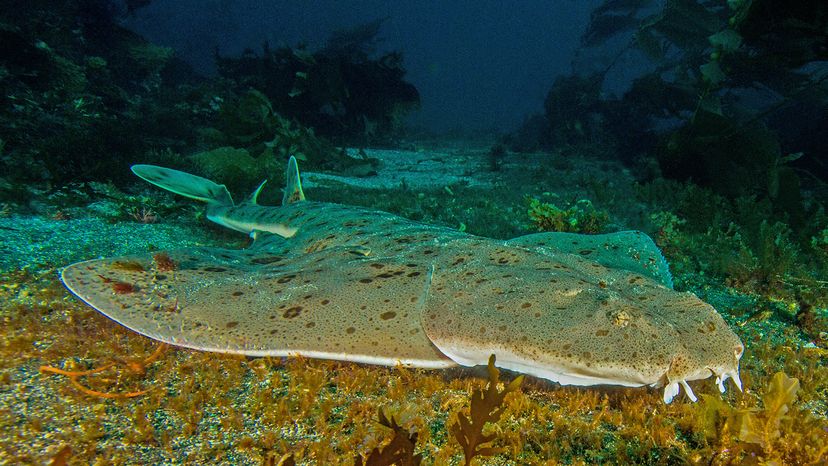
A large angel shark in California lies flat on the ocean floor, trying to blend in until prey comes close enough. Douglas Klug / Getty Images
Key Takeaways
Angel sharks, resembling rays more than typical sharks, have flattened bodies and broad pectoral fins that help them camouflage themselves on the ocean floor.
They use ambush tactics to capture prey, relying on their ability to blend in with their surroundings and their quick upward movement to attack.
Angel sharks face significant threats from habitat destruction and bycatch in fisheries, leading to their endangered status.
Is the angel shark the holiest fish in the sea? Their name certainly seems to indicate a pure and pious air, and some seafood connoisseurs say that a bite of an angel shark is like a little taste of heaven.
Or did they get the name because it's a miracle that they're classified as a shark at all?
Advertisement
After all, angel sharks certainly don't resemble the typical shark, which has a torpedo-shaped body and ominous fins that warn of its presence. Instead, the angel shark looks like it has been run over by a car or flattened by a very big iron.
The angel shark more closely resembles a skate or a ray, the bottom-dwelling cousins of the shark, but it's classified as a shark in the family Squatinidae, which has one genus: Squatina.
Squatina is Latin for "a kind of shark," perhaps reflecting early confusion about just what kind of shark this was. But certainly the name sounds right; these sharks are stocky and shorter than other sharks.
Advertisement
But what about their other name, angel shark? Squatina's 24 species of angel sharks get their name from this atypical appearance. The flaps around their head are actually flattened pectoral fins, which gives them the look of a shark with wings or a halo, like a type of angel.
While those flattened pectoral wings provide their devout moniker, they also represent the divine intervention that kept these angels classified as sharks. Whereas skates' and rays' pectoral fins are attached to their head, the angel sharks' fins are not.
This difference may be small, but it keeps these creatures in the shark family.
These flattened fins also allow them to spend a lot of time lying on the bottom of the ocean floor, waiting for a meal to swim by. But even if they're not as ferocious-looking as other sharks, don't underestimate them. Their sharp teeth and tenacious bite have earned them a nickname on the other end of the religious spectrum: sand devil.
Advertisement
Angel Shark Anatomy
As we mentioned, the angel sharks live up to their "squatty" name, with most species of Squatina measuring only about 5 feet (1.5 meters). A few species, such as the Japanese angel shark (Squatina japonica), may be as long as 6.5 feet (2 meters), but that's about as long as they get.
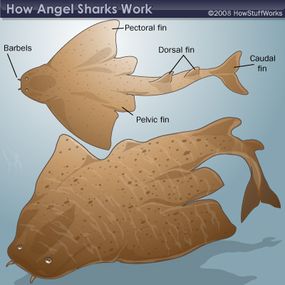
The anatomy of an angel shark.
HowStuffWorks
Most weigh about 60 pounds (27 kilograms).
Advertisement
Fins
Angel sharks look more like rays than great whites, but they have all the same basic equipment as sharks. It just happens that the equipment is flattened dorsoventrally, or from top to bottom. The broad pectoral fins that give the angel shark its name are probably the first thing to strike your eye.
To review, these fins aren't attached to the head, as they are in rays. The pelvic fins are similarly flattened and expand outward from the body.
Mouth
The mouth is located at the very tip of the snout, and inside are some truly scary teeth. Shaped like triangles, the teeth are extremely sharp and come to needlelike points.
On either side of the mouth are barbels, which are whisker-like antennae that sniff out the chemical reactions of prey along the bottom of the ocean floor.
Gills
Along the side of the head are gill slits that allow the angel shark to breathe. The positioning of the gill slits represents another important distinction from rays and skates, which have gill slits on the bottom of their heads.
Unlike many other sharks that must constantly swim to pull water over their gill slits, the angel shark uses its muscles to pull water over the gill slits while in a resting position. This shark also has a spiracle, or a tube behind the eyes that can pull in water when the shark's mouth is closed.
Tail
One way that angel sharks do differ from other sharks is their caudal fin, or tail. Most sharks' tails are top-heavy, meaning that the top lobe of the fin is bigger than the second one. The opposite holds true for angel sharks.
They have a longer lower lobe, which may help them achieve a quick liftoff when they attack their prey from below.
A Body for the Seafloor
A successful attack from below is the key to an angel shark's next meal. Many of the angel shark's features, from its flattened body to its barbels to a tail that helps it move upward quickly, allow it to live at the bottom of the ocean floor, waiting for prey to swim by.
Even its coloring provides camouflage. Angel sharks are various shades of white, gray, brown and black, colors that blend in with the ocean floor. Some have red spotting, which may provide even more coordination with their habitat.
Advertisement
Angel Shark Habitat and Hunting
Angel sharks are found all over the world, including both the western and eastern sides of the Atlantic and Pacific oceans. They're generally not found in the Indian Ocean, except for one southwestern corner.
The angel shark buried at the bottom of the ocean floor
David Doubilet/National Geographic/Getty Images
Of all the angel sharks, the Pacific angel shark (Squatina californica) is probably the most studied and best known, although many of these species are similar except for location.
Advertisement
Even if they make their homes in different parts of the world, in waters ranging from cool to tropical, angel sharks are still seeking out the same parts of the ocean. They're found on the very bottom of the ocean floor, either in shallow areas or at depths of up to 4,265 feet (1,300 meters).
How Angel Sharks Hunt
The angel shark buries itself into the sand and mud at the bottom of the ocean floor, with only its eyes poking out. They can lie there for days at a time, waiting for the perfect meal to swim by.
When this shark strikes its prey — normally bony fish, such as flounder and halibut, crustaceans or mollusks — its front half rises suddenly to ambush the prey from below. It can attack and capture its prey in a tenth of a second.
Angel sharks seem to favor one hunting spot strongly, but if the local fish figure out where the shark is hiding, then the angel shark will temporarily move several miles away.
While their barbels are constantly working, the most important sense to a hunting angel shark is its sense of sight.
In a 1999 study, Pacific angel sharks were presented with rubber fish, which didn't contain any of the same olfactory, electrical or vibratory cues of a regular fish. The angel shark struck at virtually all of the targets.
When provoked, the angel shark turns its sharp bite on humans, but generally, angel sharks have much more to fear in terms of us taking a big bite out of them.
Angel Shark Species
There are 24 types of angel sharks swimming around in the global ocean.
Squatina aculeata: sawback angel shark (found in the Mediterranean Sea and along the coast of Africa)
Squatina africana: African angel shark
Squatina albipunctata: Eastern angel shark (found along the coast of Australia)
Squatina argentina: Argentine angel shark
Squatina armata: Chilean angel shark
Squatina australis: Australian angel shark
Squatina caillieta: Cailliet's Angelshark (found in the Philippines)
Squatina californica: Pacific angel shark
Squatina david: David's angel shark (found in the Caribbean Sea)
Squatina dumeril: Atlantic angel shark
Squatina formosa: Taiwan angel shark
Squatina guggenheim: angular angel shark (found along the coast of South America)
Squatina japonica: Japanese angel shark
Squatina legnota: Indonesian angel shark
Squatina mapama: small-crested angel shark (found near Panama)
Squatina nebulosa: Clouded angel shark (found from Japan to China)
Squatina occulta: Hidden angel shark (found along the coast of South America)
Squatina oculata: Smoothback angel shark (found in the Mediterranean Sea and along the coast of Africa)
Squatina pseudocellata: Western angel shark (found off the coast of northwest Australia)
Squatina punctata: Angular angel shark (found in the Mediterranean Sea and along the coast of Africa)
Squatina squatina: Common angel shark
Squatina tergocellata: Ornate angel shark (found near Southern Australia)
Squatina tergocellatoides: Ocellated angel shark (found near Taiwan)
Squatina varii: Vari's angel shark (found off the coast of Brazil)
Advertisement
Angel Shark Fishing and Recovery
Of the 24 species of angel sharks, eight are considered critically endangered species by the International Union for Conservation of Nature (IUCN), and another four are endangered species.
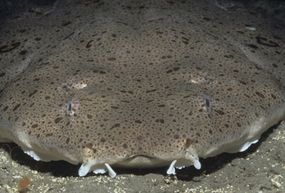
Does this look appetizing to you?
Richard Hermann/Visuals Unlimited/Getty Images
The biggest threat to angel sharks is fishing — both intentional and unintentional. These bottom-dwelling species can easily end up accidentally caught in nets meant for other fish. Habitat loss due to pollution and coastal development also threatens angel sharks.
Advertisement
Angel shark populations are particularly vulnerable to overfishing, due their low reproductive rate and slow growth. Angel sharks typically give birth to litters of just six or up to 25. The gestation period varies among species but is generally between eight and 10 months.
Angel sharks are ovoviviparous, which means that the females carries the eggs, but the eggs hatch inside and the pups are born live. Angel shark pups measure only about 9 inches (23 centimeters) at birth. Adults try to protect the small pups by giving birth in deeper waters.
The Story of the Pacific Angel Shark
Until the 1970s, Pacific angel sharks were thought of as a "junk fish," something that got caught in nets by accident. Fishers threw them back, until Michael Wagner, a seafood processor in Santa Barbara, California, began to spread the word about the tastiness of the Pacific angel shark.
Wagner's campaign was almost single-handedly responsible for bringing the Pacific angel shark to millions of plates.
According to the Monterrey Bay Aquarium, in 1977, only about 366 pounds (166 kilograms) of Pacific angel shark were caught, but by 1984, that had become 700,000 pounds (317,545 kilograms). When fishing for this shark reached its peak in 1985 and 1986, about 1.2 million pounds (544,311 kilograms) of sharks were caught each year.
A minimum size limit set in 1989 and inshore gill net ban in 1994 helped the Pacific angel shark population mostly recover, but other angel shark species remain in need of conservation.
Better Than Clearasil?
While today's divers and diners might be the only ones to meet an angel shark, that wasn't the case in 77 B.C.E. That was the year that Pliny the Elder completed his "Natural History," an encyclopedia of the natural world that was one of the leading scientific texts until the Middle Ages. It also includes some unique ways that mankind can use other inhabitants of the natural world, including angel sharks. For those cleaning house, Pliny said, the skin of an angel shark would work wonders while dusting. And if your needs were a bit more medicinal, the angel shark could help there as well. According to Pliny, angel shark flesh could relieve swollen breasts and when burnt, cure acne.
Advertisement
Frequently Asked Questions
What are the main threats to angel sharks?
The main threats to angel sharks include habitat destruction, bycatch in fisheries and illegal fishing practices.
How do angel sharks reproduce?
Angel sharks reproduce through ovoviviparity, where eggs hatch inside the female, and she gives birth to live young.
Cite This!
Please copy/paste the following text to properly cite this HowStuffWorks.com article: