Introduction to Oyster

Oyster, an edible bivalve mollusk (one with a two-pieced shell). The two parts of an oyster shell are unlike in size and shape. The three groups, or genera, of true oysters are distantly related to scallops and mussels. Other mollusks called oysters, such as pearl oysters and Bermuda oysters, are members of related bivalve families.

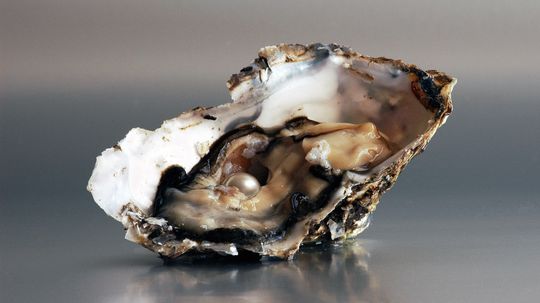
Oyster shellsOyster shells are gray-white with a rough, uneven texture.

Oysters live attached to the ocean bottom in hard-surfaced areas called oyster beds. These beds are located in deep or shallow ocean water or in the brackish water of river estuaries. They are found in all temperate and tropical oceans. Humans have eaten oysters since prehistoric times and have cultivated oyster beds and raised oysters for at least 2,000 years.

Oysters are thin and less flavorful than usual during the period from May to August—their reproductive season. This fact might account for the false belief that it is unsafe to eat oysters during months having no “r's” in their names.

Oysters vary in length from 2 inches (5 cm) to more than 12 inches (30 cm). Oysters of one group produce roundish, flat shells; those of the other two groups produce elongated, deeply cupped shells. Oyster shells are gray or whitish with an uneven texture. Some species produce shells marked with purple or red. Oyster shells are composed of calcium carbonate, the main constituent of limestone.

An oyster's body occupies the deeper of the two shells. It is surrounded by a fleshy layer of tissue called the mantle. The mantle is folded into three distinct layers: the inner layer, containing muscles; the middle layer, containing two rows of sensory organs used to detect chemical and temperature changes; and the outer layer, containing the shell-secreting membrane.

An oyster holds the parts of its shell together by contracting the centrally located adductor muscle. When the oyster relaxes, its shell is opened by a hingelike elastic horny ligament in the narrow end of the shell.

A pair of gills is located under the mantle. It is composed of layers of folded filaments, giving it a pleated appearance. The gills are used for gathering food and for respiration. At the forward end of the gills is the mouth, which is surrounded by four fleshy lobes called palps. An oyster has neither head nor brain. Instead, it has two nerve centers, one that controls the mouth and mantle, and one that controls the internal organs.

Oysters are preyed upon by marine snails, such as oyster drills and sting winkles. These mollusks drill through the shell and eat the oyster. Other dangers to oyster beds are the pink slipper, a mollusk that occupies space in the beds and crowds out the oysters, and various disease-causing protozoan parasites. Man has depleted oyster beds by overfishing and by polluting the water with industrial wastes.

Habits of Oysters

Feeding

Oysters eat organic debris (called detritus) and plankton (microscopic animals and plant). The oysters create a current in the water by beating the cilia (microscopic projections of protoplasm) on their gills. The water enters the gills where particles suspended in the water are caught in mucus. The cilia on the gills and palps sort the particles by size. They convey the smaller particles to the mouth and the large particles to the edge of the mantle to be cast out.

An oysterAn oyster holds its shell together by contracting the centrally located adductor muscle.
Reproduction and Young

Oysters can change their sex several times during their lives, but at any one time they are either male or female. (Biologists call them alternating hermaphrodites.) Most oysters spawn by releasing eggs and sperm into the water. (One group of oysters, however, retain the eggs on the gills, where they are fertilized and develop for a week before being released.) The fertilized eggs develop into swimming larvae called veliger larvae.

After about two weeks the veliger larvae land on a hard surface, such as another oyster shell or a rock, and cement themselves to it. They remain where they have set (cemented themselves) for the rest of their lives. In the three days after setting, the larvae lose their ability to swim and become miniature adults called spats. Oysters reach a marketable size when they are between three and five years of age.

Kinds of Oysters

There are approximately 100 species of true oysters, divided into three genera. Oysters of the most primitive genus, Pycnodonta, live in deep water and are inaccessible for commercial use. Most species of the two other genera, Crassostrea and Ostrea, live in shallow water.

The Crassostrea species have elongated, deep-cupped shells. They release their eggs into the water to be fertilized. The three most important members of this genus are the American Atlantic coast oyster, the Portuguese oyster, and the Japanese oyster.

Oysters of the Ostrea genus produce flat, roundish shells and retain their eggs on their gills to be fertilized there. The European flat oysters and the American Pacific coast oyster are the most widely cultivated members of this group.

Other names of oysters, such as bluepoint and lynnhaven, usually come from the name of the area in which the oysters are raised or fattened. The name “bluepoint” refers to the American Atlantic coast oysters raised near Blue Point, Long Island. Lynnhaven oysters are larger oysters of the same species. They are raised in and near Lynnhaven Bay, Virginia.

How Can You Tell an Oyster’s Age?

You can tell an oyster’s age by reading the rings on its shell. Each ring takes about one year to grow. Biologists can “read” the rings to tell how old an oyster is.

As long as its body grows, the oyster’s shell continues to grow, too. A young oyster grows at a rate of about 1 inch (2.5 centimeters) per year. Eastern oysters grow to 10 inches (25 centimeters) in length.

Oysters In Commerce

Oysters are cultivated along the Atlantic coasts of Europe and the Americas; along the Pacific coasts of the Americas, Japan, Australia, China, and Korea, and along the eastern coast of Africa. In the United States, most cultivated oysters are raised in the Middle Atlantic, Chesapeake Bay, Gulf Coast, and North Pacific fisheries.

Cultivation

Oystermen provide oysters with places to set, enough room to develop, and a good food supply. They transfer some oysters to special beds where they can fatten in the last few months before they are harvested. Oysters are harvested from the beds with dredges or tongs.

Processing

The harvested oysters are brought to a processing plant where they are washed. If they are to be sold for eating raw on the half shell, they are shucked (removed from the shell) by inserting a knife between the two halves and prying them open and placed back in one side of the shell, and then chilled, packed in ice, and sent to market. Shucked oysters are also sold, without the half shell, canned or frozen. Large commercial processing plants have automatic shucking machines.

Cooked oysters are steamed (which automatically opens the shell) and the meats are canned and sterilized. Oysters are also dried and powdered for use in soups.

Most of the oyster shells removed during processing are returned to the beds to provide places on which the larvae may set. Crushed oyster shells are fed to chickens. The shells are also burned and slaked to make lime for fertilizer.

How Does an Oyster Make a Pearl?

A beautiful pearl actually starts out as a grain of sand or dirt. Water carries the grain into an oyster’s mantle, where it settles. The rough grain can really disturb the oyster’s soft body. So the oyster uses its mantle to produce a soft substance that covers the grain. Over time, the substance hardens. Eventually, the covering over the grain grows in size and becomes a smooth pearl.

Not all oysters make perfect pearls. Chances are that any pearls you’ve seen were made by pearl oysters. True oysters, the kind people eat, sometimes make pearls, too. But their pearls look more like hard gray peas.

True oysters belong to the three genera of the oyster family, Ostreidae. Most deep-sea oysters belong to the genus Pycnodonta. The American Atlantic coast oyster is Crassostrea virginica; the Portuguese oyster, C. angulata; and the Japanese oyster, C. gigas. The European flat oyster is Ostrea edulis; the American Pacific coast oyster, O. lurida.