Featured Article: Saurolophus
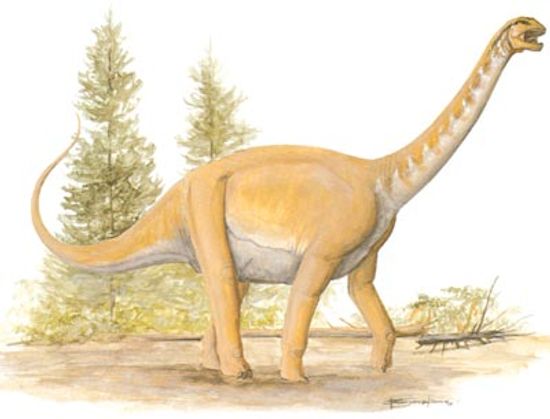
Saurolophus ("ridged reptile") was a hadrosaurid. It had a large bony spike pointing back over the top of its head between its eyes. Learn more about the Saurolophus and other Late Cretaceous dinosaurs. See more »
A period of great transformation, the Late Cretaceous Period is when the dinosaurs disappeared from the earth. Learn more about the Late Cretaceous dinosaurs that existed during this era, such as the Tyrannosaurus, Gallimimus, and Brachylophosaurus.
Saurolophus ("ridged reptile") was a hadrosaurid. It had a large bony spike pointing back over the top of its head between its eyes. Learn more about the Saurolophus and other Late Cretaceous dinosaurs. See more »
Avimimus ('bird mimic') was a small, lightly built theropod from the Upper Cretaceous Djadokhta Formation of Mongolia. Learn more about the Avimimus and other Late Cretaceous dinosaurs.
See more »Brachyceratops montanensis was found in 1913 by paleontologist Charles W. Gilmore on the Blackfeet Indian Reservation in Montana. Learn more about the Brachyceratops, Late Cretaceous dinosaurs and dinosaurs of all eras.
See more »Deinocheirus ("horrible hand") is a fascinating animal. Its front arms and three-fingered hands are nearly eight feet long. Learn more about the Deinocheirus, Late Cretaceous dinosaurs and dinosaurs of all eras.
See more »Edmontonia would not have made an easy meal for a hungry tyrannosaur. It had a heavily armored body and large, forward-pointing shoulder spines. Learn more about Edmontonia, Late Cretaceous dinosaurs and dinosaurs of all eras.
See more »The Joint Polish-Mongolian Paleontological Expeditions of the 1960s produced many new kinds of dinosaurs, many of which were small theropods. One of these theropods was a Elmisaurus. Learn more about Elmisaurus.
See more »Euoplocephalus lived at the same time and in the same areas as Edmontonia. Euoplocephalus roamed the forests cropping low plants with its broad beak. It probably ate any type of plant it came across. Learn about Euoplocephalus, Late Cretaceous dinosaurs and dinosaurs of all eras.
See more »Hadrosaurus ("thick reptile") was the first hadrosaur skeleton to be discovered. It was named and described in 1858 by Joseph Leidy, the father of American paleontology.
See more »Kritosaurus was a large, flat-headed duckbilled dinosaur. It had a ridge of bone between the eyes and the snout that gave it a distinguished "Roman nose" appearance.
See more »Leptoceratops, the first known protoceratopsid, was found along the Red Deer River of Alberta, Canada, in 1910. This partial skull and skeleton was named Leptoceratops gracilis.
See more »Monoclonius was discovered by Edward Drinker Cope in 1876 along the Missouri River in Montana. Learn about Monoclonius, Late Cretaceous dinosaurs and dinosaurs of all eras.
See more »Known from only a single skull and jaw from Montana and three teeth from South Dakota, Nanotyrannus was first thought to be an Albertosaurus. But it was recently redescribed because it was different in many ways from Albertosaurus.
See more »The first specimen of Oviraptor was discovered by the American Museum of Natural History expedition to Asia in 1923. It was found in the Gobi Desert of Mongolia.
See more »Parasaurolophus was an interesting-looking dinosaur. While it looked normal from the neck down, it looked almost as if it had a trombone on its head. And in a way, it did.
See more »Not many fossils of Parksosaurus have been found. It is known only from a single skeleton and poorly preserved skull from the southern part of Alberta. Learn about Parksosaurus, Late Cretaceous dinosaurs and dinosaurs of all eras.
See more »Known only from the Late Cretaceous of northwestern New Mexico, Pentaceratops had one large horn on its snout, a pair of large horns above its eyes, and a pair of much smaller false horns in the cheek region. Its name means "five-horned face." The horns were actually bone.
See more »In 1912, a German paleontological expedition discovered the remains of several new Late Cretaceous dinosaurs in Egypt. Spinosaurus, a large theropod, was one of the new dinosaurs. It got its name, which means "spined reptile," because of the tall spines on its vertebrae (bones of the spine).
See more »Stegoceras has been one of the more interesting dinosaurs, partly because of the tangle of names that have been attached to it and also because of explanations that have been attached to its domed skull.
See more »Struthiomimus ("ostrich mimic") is the best known of all the ornithomimids. A complete skeleton, which is now displayed at the American Museum of Natural History, was collected from the Judith River Formation of Alberta. Its name points to how similar its skeleton is to the modern Struthio (ostrich).
See more »Styracosaurus was discovered in 1913 in the Belly River Formation of Alberta by Charles Sternberg. Lawrence Lambe named this animal Styracosaurus albertensis, which means "spiked reptile of Alberta," for its unusual neck frill.
See more »In 1948, several giant claw bones were found by a Soviet-Mongolian scientific team and because the shape of the claws is similar to the claws of some turtles , workers first thought they belonged to a giant turtle, so the specimen was named Therizinosaurus cheloniformis ("turtlelike scythe reptile").
See more »